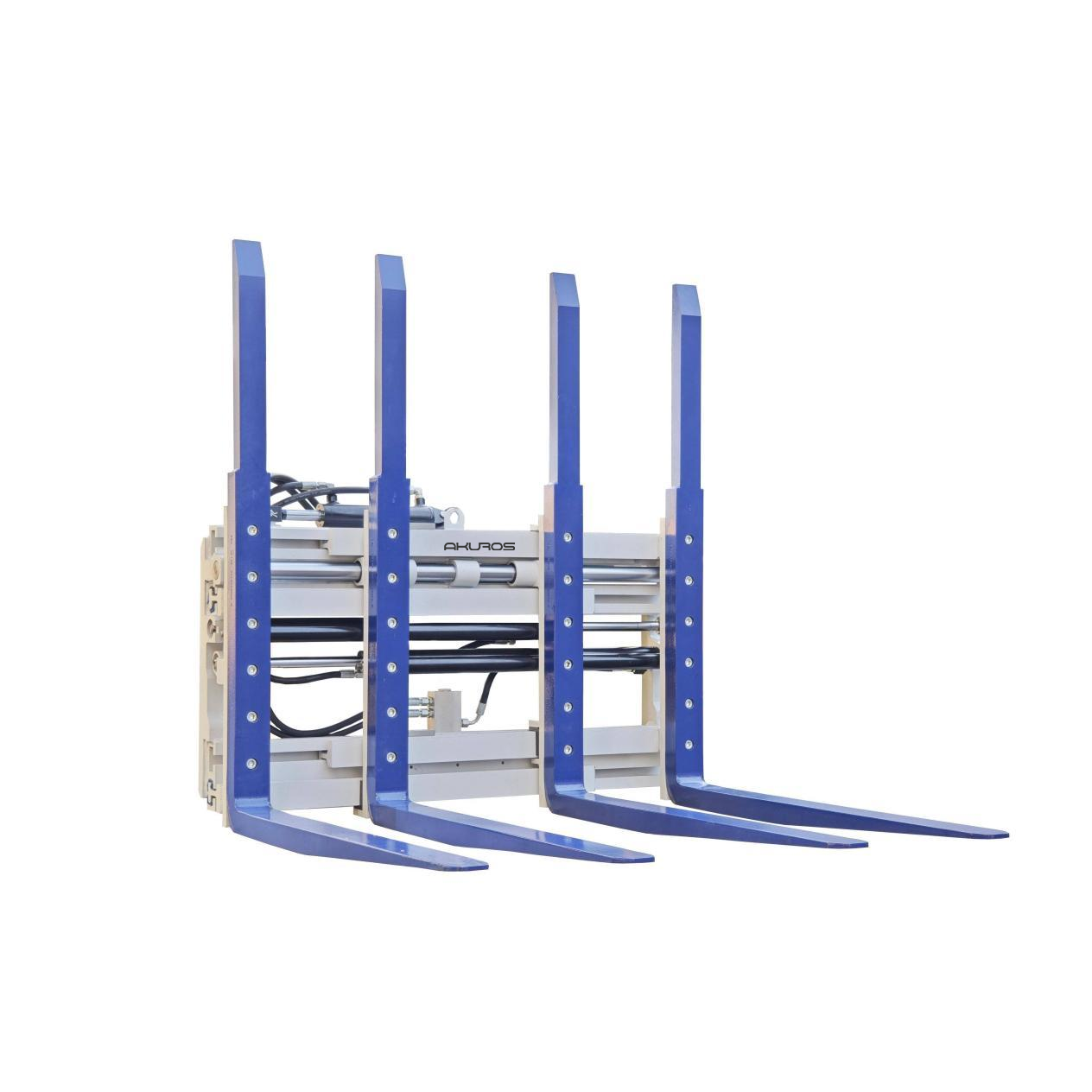
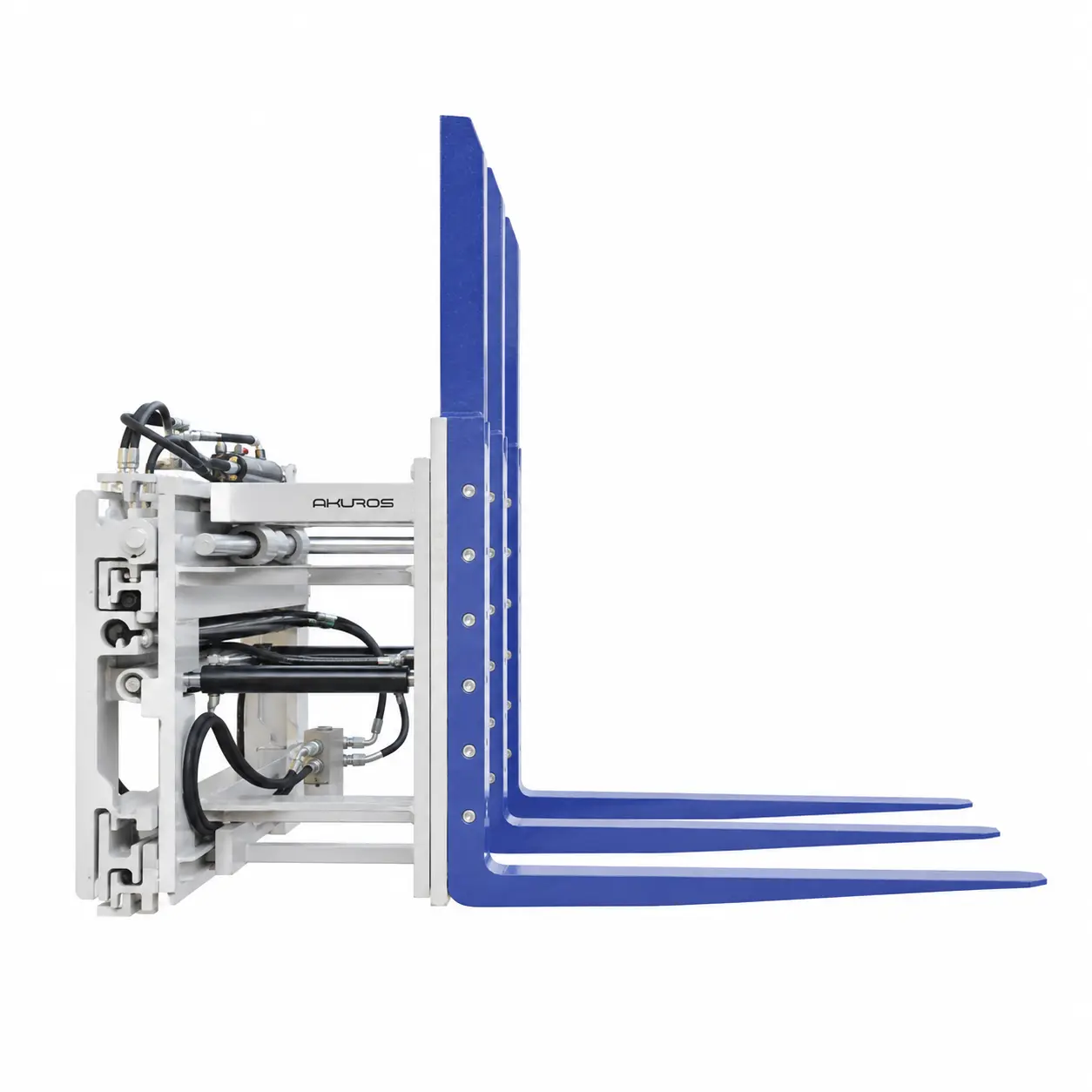
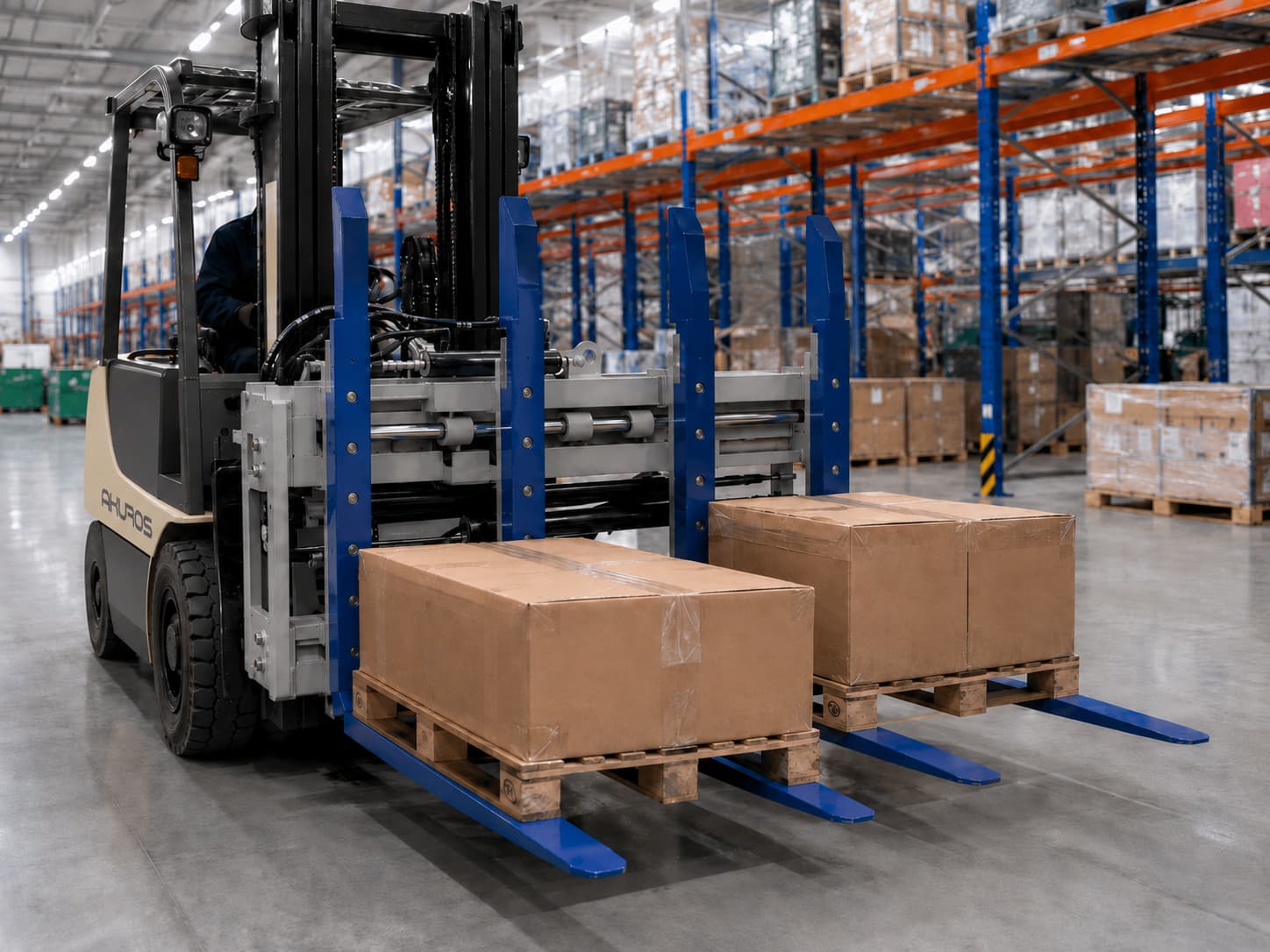
Single-Double Pallet Handler Attachment

Hydraulic Forklift Attachment for High-Volume Single- and Double-Pallet Handling

Integrated Hydraulic Systems Improve Pallet Handling Precision

Hydraulic Independent Fork Positioning

The attachment uses hydraulic independent fork positioning to adjust fork spacing according to pallet width, pallet separation, and the selected single- or double-pallet operating mode.

This reduces manual fork adjustment and helps operators align the forks more efficiently with standardized pallet openings. The adjustment range should be configured according to the actual minimum and maximum pallet spacing required by the project.

If the operation only requires adjustable fork spacing, choose a standard fork positioner. If the operation must also move two standardized pallets in one cycle, choose a Single/Double Pallet Handler after confirming forklift capacity and hydraulic compatibility.

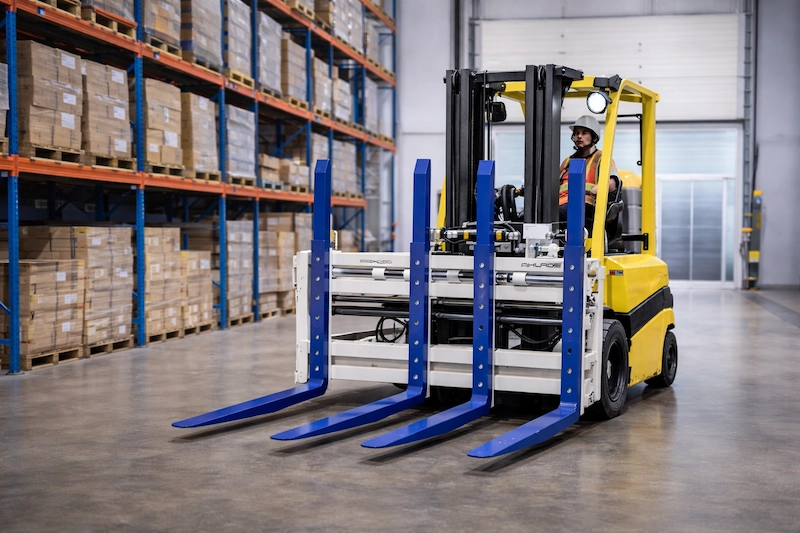
Single-Double Pallet Handler Attachment for Counterbalance Forklift
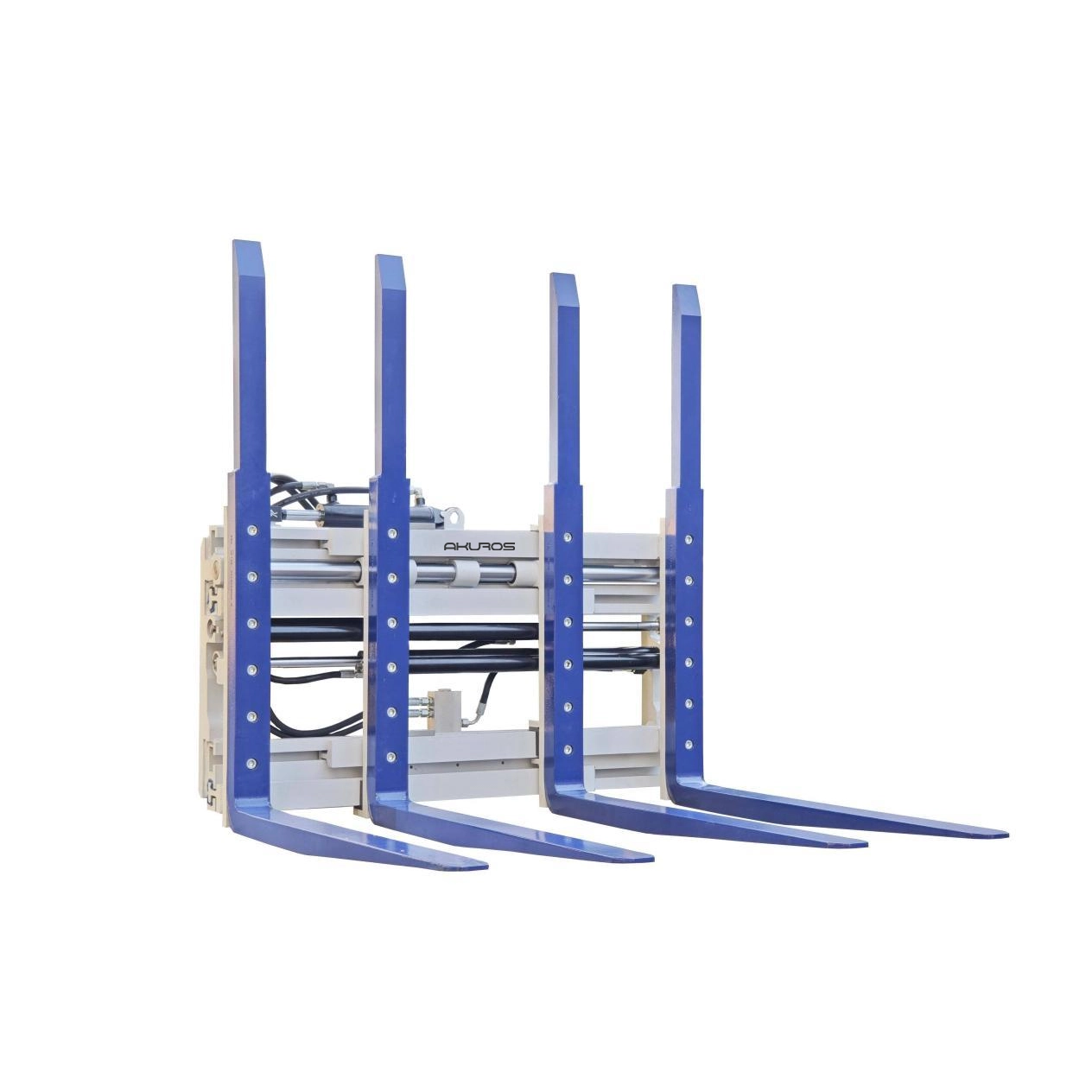
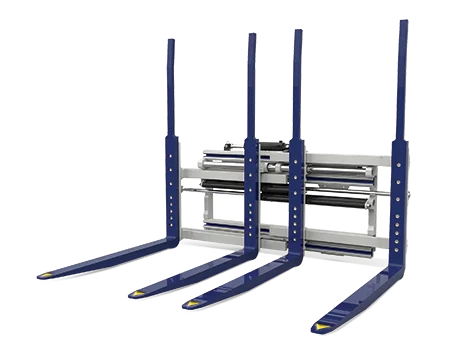
Single-Double Pallet Handler Attachment

Synchronized Hydraulic Cylinder Control

The hydraulic system uses synchronized cylinder movement to support balanced fork adjustment and accurate pallet engagement. Smooth synchronized movement helps prevent uneven fork positioning when engaging one or two pallets.

The forklift must provide suitable hydraulic flow, operating pressure, auxiliary hydraulic functions, hose routing, and control connections. Hydraulic specifications should be reviewed before production rather than after the attachment arrives at the site.

If hydraulic flow is insufficient, fork movement may become slow or uneven. Incorrect pressure, hose routing, or auxiliary functions can prevent the attachment from operating reliably.

Key Features for Safe High-Volume Pallet Handling

Single- and Double-Pallet Handling Flexibility

The attachment allows the operator to handle one pallet or two pallets according to the workflow, load condition, and available operating space.

Single-pallet mode is suitable where positioning accuracy, narrow space, or special load conditions are more important. Double-pallet mode is suitable for standardized pallet flows where moving two loads together creates measurable throughput gains.

This flexibility allows one forklift to support both routine pallet handling and higher-volume dock or transfer operations.

Heavy-Duty Welded Steel Structure

The attachment uses a heavy-duty welded steel frame designed to distribute forces during lifting, turning, braking, and pallet transport.

Double-pallet operation increases front-end weight and may move the effective load center farther forward. Reinforced structural design supports durability in repetitive warehouse and dock operations.

Structural strength does not replace capacity verification. The combined pallet load, attachment weight, and changed load center must remain within the forklift’s calculated residual capacity.

ISO/FEM Forklift Carriage Compatibility

The attachment is designed for integration with ISO 2328 and FEM forklift carriage standards, subject to the actual carriage class and mounting dimensions.

Buyers should confirm carriage class, carriage width, mounting-hook position, clearance, hydraulic hose routing, and forklift model before production.

If the carriage class or mounting dimensions are incorrect, the attachment may not fit the forklift safely.

Higher Pallet Throughput with Fewer Forklift Cycles

Reduced Forklift Travel Frequency

Moving two pallets in one operating cycle can reduce the number of trips required between storage, staging, production, and dispatch areas.

Fewer travel cycles can reduce operator travel time, equipment energy use, aisle congestion, and loading-dock delays when pallet dimensions and load conditions are standardized.

If daily pallet volume is high and the same route is repeated frequently, double-pallet handling can provide measurable efficiency gains.

Faster Loading Dock Throughput

Loading docks and cross-docking operations often lose time when forklifts repeatedly move one pallet at a time between staging lanes and trailers.

When forklift capacity, trailer layout, pallet dimensions, load stability, and turning space permit, double-pallet handling can increase the number of pallets moved per trip and support faster vehicle turnaround.

The combined pallet width, dock clearance, aisle width, and trailer layout must be reviewed before approving double-pallet operation.

Accurate Hydraulic Pallet Engagement

Hydraulic fork positioning and synchronized movement help operators align the forks with pallet openings without repeated manual adjustment.

More accurate engagement can reduce repositioning time and support smoother pallet pickup in repetitive high-volume operations.

Pallet dimensions, pallet condition, fork thickness, required spacing, and load stability should be standardized before double-pallet handling becomes part of the daily workflow.

Attachment Maintenance and Compatibility Risk Control

Hydraulic Hose, Cylinder, and Seal Inspection

Hydraulic hoses, fittings, cylinders, seals, valves, and connection points should be inspected regularly for leakage, wear, contamination, loose connections, and physical damage.

Uneven or slow fork movement may indicate insufficient hydraulic flow, air in the system, seal wear, contamination, or incorrect pressure settings.

Continued use without inspection may reduce fork-positioning accuracy and pallet stability.

Fork, Frame, and Mounting Inspection

Forks, welded joints, mounting hooks, guide rails, bearings, sliding surfaces, and load backrest components should be checked for deformation, cracks, abnormal wear, loose mounting, and insufficient lubrication.

High-cycle double-pallet operation can increase structural and sliding-component stress. Regular inspection helps identify wear before it affects fork alignment or attachment safety.

Residual Capacity and Load Stability Review

Residual capacity should be reviewed whenever the attachment is installed on a different forklift, the mast configuration changes, the pallet weight increases, or a different load center is introduced.

Do not assume that the forklift’s original rated capacity remains available after installation. Attachment weight, forward load position, combined pallet weight, mast height, and attachment geometry all affect safe lifting capacity.

Using the attachment without recalculating residual capacity can create load instability, steering problems, reduced braking control, or unsafe lifting conditions.

Configuration Options

Mounting Class, Dimensions, and Fork Spacing

ISO/FEM mounting class, carriage width, attachment width, mounting-hook position, fork length, fork thickness, minimum opening, and maximum fork spacing can be configured according to the forklift and pallet dimensions.

Hydraulic Functions and Hose Configuration

Hydraulic flow, operating pressure, auxiliary hydraulic circuits, control functions, hose length, hose routing, and connector requirements can be matched to the selected forklift.

Reinforcement and Cold Storage Package

Structural reinforcement, load backrest, hydraulic oil, seals, lubrication, steel treatment, and corrosion protection can be configured according to pallet load, handling frequency, and low-temperature operating requirements.

Typical Applications

FMCG and Food & Beverage Warehouses

Suitable for standardized high-volume pallet flows involving beverages, packaged food, consumer products, and other repeatable warehouse loads where reducing forklift cycles improves throughput.

Distribution Centers and Cross-Docking

Supports rapid pallet transfer between receiving, staging, storage, and outbound loading areas where dock turnaround time, trailer loading speed, and aisle flow are important operating targets.

Manufacturing and Loading Dock Operations

Suitable for repetitive movement of finished products, packaging materials, production output, and standardized pallets between manufacturing lines, staging areas, warehouses, and loading docks.

Interested in a High Capacity Reach Truck?

A representative from your local Solutions & Support Center will use the information you provide below to develop the best solution for you.


    Get A Free Quote
    Contact us for free quotes and more professional knowledge about product. We will prepare a professional solution for you.


      Leave Your Message


        Leave Your Message