


The simplest Pallet Truck can look like a commodity: two forks, several wheels and a hydraulic pump. In real warehouse operations, however, a poor equipment choice can create slow travel, difficult pallet entry, excessive operator effort, damaged wheels, poor maneuverability or an expensive electric truck whose battery system does not match the shift schedule. The better buying process begins with the material flow. How heavy is the heaviest pallet? How far does it travel? How many moves occur per shift? Is the floor smooth? Are there dock plates, gradients, cold rooms or narrow aisles? These questions should be answered before comparing machine prices. AKUROS positions itself as a warehouse and logistics solutions provider combining equipment, planning and consulting, so buyers evaluating AKUROS warehouse and logistics solutions should still begin by describing the actual work cycle rather than asking for one universal pallet truck model.
The purchasing conversation becomes much more precise when the buyer supplies measurable conditions. A distribution center may need a powered truck that travels repeatedly from receiving docks to storage lanes. A supermarket may move only a few pallets from the backroom to the shop floor. A factory may handle three-ton loads but only over short distances. Another warehouse may carry lighter goods continuously for two shifts. These operations do not create the same equipment requirement. Buyers should document pallet dimensions, maximum load, daily handling frequency, average one-way travel distance, aisle width, floor condition, gradient, operating temperature and available charging infrastructure. With that information, purchasing teams can contact AKUROS for a Pallet Truck recommendation based on the real warehouse layout instead of comparing capacity numbers that may have little relationship to the actual job.
The next step is understanding the available equipment range. “Pallet truck” can describe a manually pumped hand truck, a pedestrian electric walkie, a powered platform truck or a stand-on model designed for higher travel intensity. Each solves a different productivity problem. AKUROS currently groups manual and electric units within its Pallet Truck range, with electric models aimed at short-distance warehouse transfer, loading docks and internal movement and manual options for simpler handling. Current published models include powered units around the 2.0–2.2 ton direction as well as a 3.0-ton manual model. These examples are useful for understanding the range, but model selection should still be based on the pallet, floor, distance, traffic and shift rather than assuming higher rated capacity automatically means better productivity.
Safety is also part of equipment selection, not an operator issue that begins after delivery. Forks need to enter the pallet correctly; the load should be centered and stable; operators need clear travel routes; powered models require competent operation and workplace-specific training; and manual units can still create significant pushing and pulling demands when heavy pallets, rough floors or slopes are involved. The correct truck can reduce unnecessary manual handling, but no Pallet Truck eliminates the need for safe operating procedures. Warehouse managers can use the practical principles in how to use a Pallet Truck correctly in a warehouse alongside the machine manual and local regulations. Equipment, training, traffic management and maintenance should be treated as one operating system.
Manual trucks remain highly relevant because they are simple, immediately available and do not require batteries or chargers. They can be particularly effective where distances are short and loads are moved intermittently. AKUROS’s M30 Hand Pallet Truck, for example, is currently published with a 3.0-ton maximum rated capacity and lift height up to 200 mm, using manual hydraulic lifting rather than an electric drive system. That makes it a useful example of a high-capacity manual direction, but the ability to lift three tonnes should not be confused with the ergonomic practicality of manually moving a three-tonne pallet over a long route. Load, rolling resistance, floor condition and travel distance still determine the real operator effort.
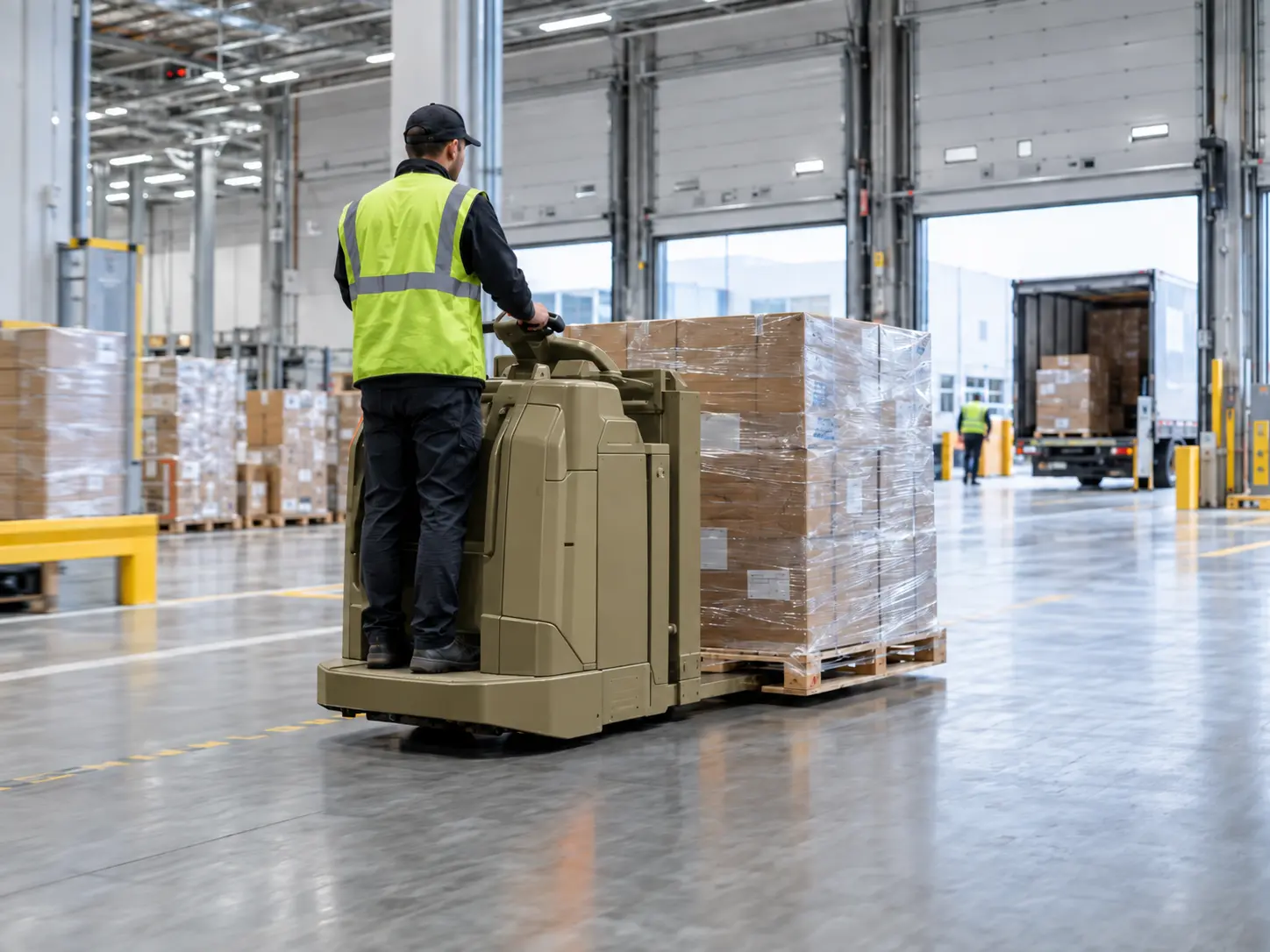
At the other end of the operating spectrum, repeated medium-distance transfer can justify a powered ride-on or stand-on format. AKUROS’s current T20 Stand-On Electric Pallet Truck is listed at 2.0 tons with a 24 V battery system and lift height up to 205 mm, and the product page positions it for medium- and longer-distance internal transport, distribution centers, docks and intensive daily work. Published battery-capacity options include 180 Ah, 240 Ah and 270 Ah depending on configuration. Those figures illustrate why electric selection cannot stop at voltage: battery capacity, route, shift length, load, gradient, charging strategy and ambient temperature all affect whether a truck can complete the expected working cycle.
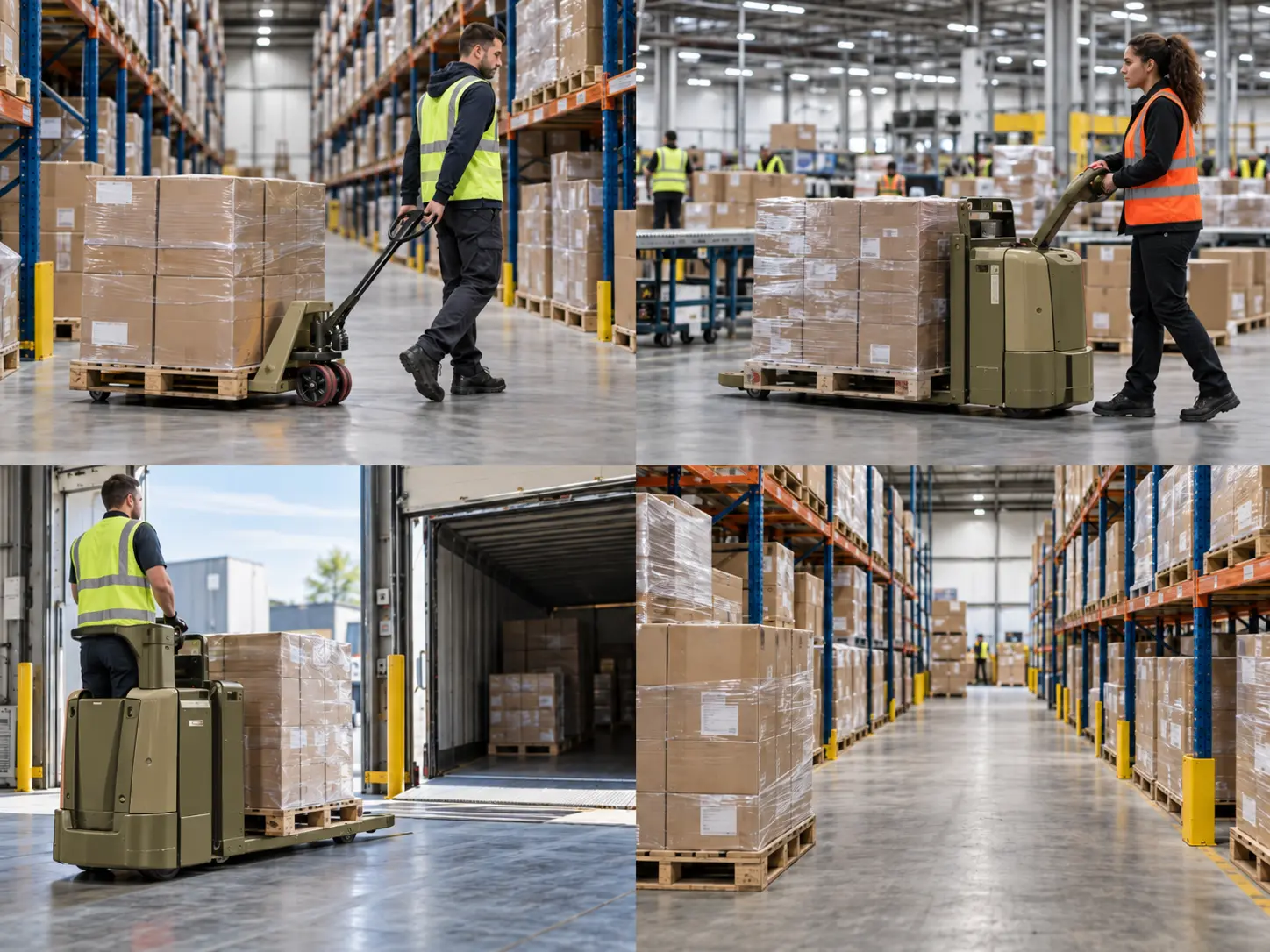
Wholesale Pallet Trucks
Quick Answer: How Do You Choose the Right Pallet Truck?
Use this six-step sequence:
- Confirm the heaviest pallet the truck will actually move.
- Confirm pallet entry dimensions and required fork geometry.
- Measure travel distance and pallet moves per shift.
- Review aisle width, turning space, floor and gradients.
- Choose manual, electric walkie or ride-on operation.
- Compare safety, maintenance, battery and total ownership cost.
| Operating Condition | Starting Direction |
|---|---|
| Occasional short moves on smooth floor | Manual Pallet Truck |
| Frequent short warehouse movements | Electric walkie Pallet Truck |
| Repeated medium / long internal travel | Stand-on or ride-on powered Pallet Truck |
| High load but short travel | Heavy-duty rated model after ergonomic review |
| Very low pallet entry | Low-profile Pallet Truck |
| Cold-storage operation | Cold-environment-compatible electric configuration |
| Washdown / corrosive environment | Appropriately protected or stainless configuration |
Buyer rule: select the truck from the full work cycle. Capacity answers “can it lift the load?” but distance, frequency, floor and ergonomics answer “can it move that load efficiently all day?”
What Is a Pallet Truck?
A Pallet Truck is a low-lift industrial truck designed to raise a pallet only enough for horizontal transport rather than stacking it at rack height. Fork arms enter the pallet openings, lift the load clear of the floor and allow the pallet to be transported.
Depending on design, lift and travel may be:
- fully manual;
- manual lift with powered travel;
- fully electric;
- pedestrian-controlled;
- stand-on;
- ride-on.
Typical applications include warehouses, supermarkets, production lines, distribution centers, loading areas and internal logistics.
Pallet Truck vs Pallet Jack vs Pump Truck
These terms overlap heavily.
Pallet Truck
A broad international term that can include both manual and powered low-lift pallet-handling machines.
Pallet Jack
Common in North American usage and often refers to a manual pallet truck, although “electric pallet jack” is also widely used.
Pump Truck
Common UK terminology for a manual hydraulic pallet truck because the operator pumps the tiller to raise the forks.
When buying internationally, specify the actual machine configuration rather than relying on terminology alone.
Main Types of Pallet Trucks
Manual Pallet Truck
A manual truck uses a hydraulic pump to lift the load and human force to push or pull the truck.
Strong applications include:
- occasional pallet movement;
- small warehouses;
- retail backrooms;
- short loading-area transfers;
- backup equipment.
Electric Walkie Pallet Truck
The operator walks behind or beside the machine while electric drive power moves the truck.
Strong applications include:
- frequent warehouse transfer;
- higher daily pallet counts;
- operations seeking lower pushing effort;
- loading docks;
- production-line logistics.
Stand-On or Ride-On Pallet Truck
A platform or operator position allows the user to travel with the truck, making these machines more suitable when route length becomes significant.
Heavy-Duty Pallet Truck
Heavy-duty units provide higher rated capacity for heavier industrial loads. Higher capacity should be selected because the load requires it—not because a larger number appears more robust.
Low-Profile Pallet Truck
These are designed for pallets whose entry opening is too low for conventional forks.
Stainless or Corrosion-Resistant Pallet Truck
Suitable configurations may be used in food, pharmaceutical, marine or corrosive environments where ordinary painted steel equipment may not be appropriate.
Scissor Pallet Truck
Scissor-lift designs can raise pallets to a higher ergonomic work position in addition to horizontal transport.
Manual vs Electric Pallet Truck
| Factor | Manual | Electric |
|---|---|---|
| Initial cost | Lower direction | Higher direction |
| Travel effort | Operator powered | Motor powered |
| Short occasional moves | Very strong fit | May be unnecessary |
| High move frequency | Operator fatigue can increase | Strong fit |
| Longer travel | Less favorable | More suitable, especially platform / ride-on designs |
| Charging infrastructure | Not required | Required |
| Maintenance complexity | Relatively simple | Battery, drive and electrical systems added |
| Operator training | Safe-use instruction required | Powered-truck requirements may apply by jurisdiction |
When Does an Electric Pallet Truck Make Sense?
There is no universal number of pallet moves that automatically justifies electric drive.
A better workload model is:
Then consider:
- number of shifts;
- average load;
- floor resistance;
- operator fatigue;
- waiting time;
- labor cost;
- required throughput.
As total travel and frequency increase, powered travel becomes more valuable because the operator no longer provides the primary propulsion force.
How to Choose Pallet Truck Load Capacity
Select capacity from the heaviest credible pallet, not the average pallet.
Then verify the manufacturer’s operating conditions and load distribution requirements.
Check
- maximum product weight;
- pallet weight;
- containers or stillages placed on the pallet;
- load stability;
- distribution across forks;
- attachments or optional equipment.
Never exceed the truck’s manufacturer-rated capacity. A Pallet Truck with sufficient nominal capacity can still be unsafe if the load is unstable, poorly positioned or incompatible with the forks.
Common Capacity Classes
Typical market directions include:
| Capacity Direction | Typical Use Direction |
|---|---|
| 1.5 t | Lighter warehouse and retail handling |
| 2.0 t | Common electric warehouse work |
| 2.2–2.5 t | Higher-capacity electric or manual handling |
| 3.0 t+ | Heavy-duty manual / industrial applications |
These are market examples rather than universal classifications. Verify actual model specifications.
Why More Capacity Is Not Always Better
Oversizing can increase:
- truck weight;
- cost;
- turning space;
- rolling resistance;
- battery or drive demand on powered equipment.
The target should be adequate capacity with an appropriate operational margin based on the real load—not simply the biggest model available.
Fork Length and Width Matter as Much as Capacity
A truck that can lift the weight but cannot enter the pallet is useless.
Confirm
- fork length;
- individual fork width;
- outside fork width;
- fork spacing;
- lowered fork height;
- raised fork height.
Pallet Compatibility
Pallet standards differ across regions and industries.
Common examples include:
- EUR / EPAL pallets;
- CHEP pallets;
- North American GMA pallets;
- industrial pallets;
- custom steel pallets;
- display pallets;
- closed-bottom or specialty pallets.
Always compare the actual underside entry geometry with the truck’s fork dimensions.
Why Lowered Fork Height Can Decide the Purchase
A low-clearance pallet may physically block a conventional fork from entering even when capacity, length and width are correct.
Measure the pallet’s clear fork-entry height under loaded conditions, not only the new empty pallet.
Fork entry comes before load capacity: if the truck cannot enter the pallet safely, the rest of the specification is irrelevant.
Pallet Truck Wheels Explained
Polyurethane
Polyurethane wheels are common on warehouse trucks because they can provide a useful balance of rolling resistance, floor protection and noise.
Nylon
Nylon can provide low rolling resistance and good durability on smooth hard floors, but it may create more noise and transmit more vibration.
Rubber
Rubber can provide quieter operation and grip in selected conditions, although rolling resistance may be higher.
Wheel material should be selected from actual floor conditions, load, contaminants and environment. Do not assume one wheel compound is universally best.
Single vs Tandem Load Rollers
Single load rollers are simple and effective on smooth floors.
Tandem rollers can spread contact across multiple wheels and may travel more smoothly over:
- floor joints;
- thresholds;
- dock plates;
- minor surface irregularities.
Large steps, damaged floors or major holes should be repaired rather than treated as normal pallet-truck terrain.
How Floor Condition Changes the Choice
Small Pallet Truck wheels react strongly to floor defects.
Evaluate
- smoothness;
- cracks;
- expansion joints;
- dock plates;
- debris;
- wet or oily areas;
- slopes;
- outdoor transitions.
HSE has specifically highlighted cases where conventional manual pallet trucks became difficult to push on uneven construction floors, increasing manual-handling risk. Floor suitability should therefore be part of the equipment specification.
Travel Distance Is a Major Selection Variable
Manual equipment can be highly effective for short moves but increasingly tiring as distance rises.
Short Distance
Manual or compact electric trucks can both be appropriate depending on frequency and load.
Frequent Medium Distance
Electric walkie models reduce propulsion effort.
Long Internal Travel
Stand-on or ride-on machines deserve stronger consideration because walking itself becomes a productivity constraint.
Aisle Width and Turning Radius
Do not choose a truck from chassis width alone.
Turning requires space for:
- truck length;
- tiller swing;
- pallet length;
- load overhang;
- operator position;
- rack clearance.
Use the manufacturer’s turning-radius and aisle requirements with the actual pallet attached.
Ramp and Gradient Capability
A slope changes traction, braking and load-control requirements.
Verify:
- maximum loaded gradient;
- maximum unloaded gradient;
- brake system;
- traction;
- surface condition;
- manufacturer operating restrictions.
Never assume a flat-floor Pallet Truck can safely operate on a ramp simply because the motor has enough power.
Manual Pulling and Pushing Effort
A manual truck does not eliminate manual handling; it changes the way the load is moved.
Operator effort rises with:
- heavier loads;
- rough floors;
- small or damaged wheels;
- gradients;
- long travel;
- frequent starting;
- tight steering.
Where these factors occur together, electric drive may deliver ergonomic value even when the load itself is within manual-truck capacity.
Battery Options for Electric Pallet Trucks
Lead-Acid Batteries
Lead-acid technology is mature and widely supported but can require scheduled charging, maintenance and battery-room procedures depending on the system.
Lithium-Ion Batteries
Lithium-ion systems can support opportunity charging and lower routine battery maintenance in many warehouse applications.
Lithium is not automatically the lowest-cost option. Compare purchase price, charger, duty cycle, service support and expected life for the actual operation.
Battery Voltage vs Battery Capacity
Voltage and amp-hour capacity describe different electrical characteristics.
For example, a nominal 24 V, 240 Ah battery contains approximately:
This does not mean the truck will deliver exactly 5.76 kWh of usable work. Actual runtime depends on battery management, discharge limits, load, acceleration, travel speed, gradients and temperature.
How to Plan Battery Runtime
Do not ask only “How many hours does the battery last?”
Provide:
- moves per shift;
- average travel distance;
- average load;
- gradient;
- shift duration;
- break times;
- charging windows;
- ambient temperature.
The supplier can then recommend battery capacity against a realistic duty cycle.
Charging Strategy
Single-Shift Warehouse
Overnight charging may be practical if the battery comfortably completes the shift.
Multi-Shift Warehouse
The operation may need:
- larger battery capacity;
- opportunity charging;
- spare batteries;
- scheduled charging breaks;
- fast-charge-compatible equipment.
Cold-Storage Pallet Trucks
Cold environments can affect battery performance, lubrication, condensation and electronic reliability.
A cold-store specification should review:
- temperature rating;
- battery performance;
- electrical protection;
- connectors;
- lubrication;
- condensation after moving between temperature zones.
Use equipment configured and approved for the intended temperature range.
Pallet Trucks for Loading Docks
Loading docks can create more demanding conditions than a smooth warehouse aisle.
Consider:
- dock plates;
- bridge plates;
- trailer-floor condition;
- gradients;
- thresholds;
- wheel material;
- trailer restraint;
- lighting.
Electric Pallet Truck Safety Features
Depending on model, safety features can include:
- emergency reverse switch;
- automatic braking;
- parking brake;
- horn;
- speed reduction during turning;
- creep / low-speed mode;
- PIN or access control;
- warning lights;
- operator-presence systems.
Verify the features installed on the exact model rather than assuming every electric truck has the same safety package.
Pre-Use Inspection Checklist
Manual Pallet Truck
- forks free from major damage;
- wheels and load rollers rotate correctly;
- hydraulic unit does not leak;
- handle and lowering control work correctly;
- truck rolls and steers normally;
- capacity marking is legible.
Electric Pallet Truck
- battery charge and connectors;
- forks and load wheels;
- steering controls;
- service and parking brake;
- emergency reverse;
- horn and warning devices;
- visible damage or fluid leaks;
- display warnings or fault codes.
Safe Pallet Truck Operation
- Inspect the truck before use.
- Inspect the pallet and load condition.
- Confirm the load is within rated capacity.
- Insert forks sufficiently beneath the pallet.
- Center and stabilize the load.
- Raise only enough for transport.
- Keep feet and hands clear of wheels and forks.
- Travel at a controlled speed.
- Maintain visibility and watch pedestrians.
- Slow for turns, slopes and dock transitions.
- Park with forks lowered where required.
Pallet Truck Supplier
Training and Compliance: Manual and Powered Trucks Are Not the Same
United States
OSHA 29 CFR 1910.178 covers powered industrial trucks, including motorized hand trucks. Employers must ensure powered-industrial-truck operators are competent through required training and workplace evaluation.
The rule should not be casually applied to purely manual hand pallet trucks as if they were motorized equipment, although employers still have general duties to provide safe equipment and work practices.
United Kingdom
PUWER requires workplace equipment to be suitable for intended use, maintained safely and used by people with adequate information, instruction and training.
LOLER applicability depends on the equipment and lifting function. HSE guidance notes that conventional low-lift pallet trucks may fall outside LOLER where the consequence of a load falling is low, while high-lift pallet trucks capable of raising forks above 300 mm are specifically addressed under LOLER guidance.
Do not mix U.S., UK or EU legal requirements. Compliance should be checked for the jurisdiction where the equipment will actually operate.
ISO Safety Standards: Know the Scope
ISO 3691-5:2014 addresses safety requirements for certain pedestrian-propelled industrial trucks, including specified low-lift pallet trucks.
Its published scope includes low-lift pallet trucks with lift height up to 300 mm and rated capacity up to 2,300 kg.
This means ISO 3691-5 should not automatically be claimed as covering every higher-capacity manual Pallet Truck. Check the exact standard scope and product certification.
Pallet Truck Maintenance
Manual Truck Maintenance
Typical service points include:
- steering wheels;
- load rollers;
- bearings;
- hydraulic pump;
- seals;
- fork structure;
- handle linkage;
- lowering valve.
Electric Truck Maintenance
Electric models add:
- battery;
- drive motor;
- lift motor where applicable;
- controller;
- electrical connectors;
- brake system;
- charger;
- display and sensors.
Maintenance Warning Signs
Investigate:
- slow or uneven lifting;
- hydraulic leaks;
- worn or chunked wheels;
- abnormal noise;
- poor braking;
- reduced battery runtime;
- steering resistance;
- fault codes;
- fork deformation.
Total Cost of Ownership
The cheapest purchase price does not automatically create the lowest operating cost.
Manual vs Electric Total Cost
| Cost Element | Manual | Electric |
|---|---|---|
| Initial purchase | Lower direction | Higher direction |
| Energy / charging | None | Required |
| Mechanical maintenance | Simple direction | More systems |
| Battery replacement | None | Lifecycle consideration |
| Operator travel effort | Higher | Lower |
| High-frequency productivity | Can become limiting | Potential advantage |
How to Calculate Whether Electric Power Is Worth Evaluating
One useful internal metric is total pallet travel.
Illustrative Example
A warehouse makes 80 pallet trips per day with an average round-trip distance of 90 m:
Over 250 operating days:
At that point, travel effort and operator walking time deserve serious evaluation. The calculation does not prove an electric truck will automatically pay back; it shows why a powered option should be compared using real labor and productivity data.
Real Scenario 1: Small Retail Stockroom
A store moves ten to fifteen pallets per day over short, flat routes.
Likely priorities:
- low purchase cost;
- simple maintenance;
- compact storage;
- immediate availability.
A manual Pallet Truck can be entirely appropriate if the loads and floor allow comfortable handling.
Real Scenario 2: Busy Distribution Warehouse
A warehouse moves pallets continuously between receiving, storage and picking lanes.
Priorities include:
- reduced walking effort;
- frequent starts and stops;
- compact turning;
- battery planning;
- higher daily throughput.
An electric walkie truck is a strong candidate.
Real Scenario 3: Large Logistics Center
Loads travel hundreds of meters between docks and storage zones.
At this distance, the operator’s walking speed becomes part of cycle time.
A stand-on or ride-on Pallet Truck may offer a better productivity fit, subject to aisle space, traffic control and training.
Real Scenario 4: Cold Storage
A refrigerated distribution center operates below normal warehouse temperature.
Selection should focus on:
- cold-compatible battery performance;
- electrical protection;
- condensation;
- traction;
- low-temperature components;
- charging location.
Real Scenario 5: Heavy Factory Loads
A factory occasionally moves pallets approaching three tonnes but only a short distance.
A high-capacity manual model may appear attractive because it avoids battery complexity.
But the purchasing team should still test:
- starting force;
- floor condition;
- turning;
- operator frequency;
- grade changes.
Capacity alone does not prove ergonomic suitability.
Ten Common Pallet Truck Buying Mistakes
Mistake 1 — Buying by Price Only
Risk: the truck does not fit the workflow.
Better decision: compare total operating requirements.
Mistake 2 — Using Average Load Instead of Maximum Load
Risk: occasional heavy pallets exceed capacity.
Better decision: specify from the heaviest credible pallet.
Mistake 3 — Choosing the Wrong Fork Dimensions
Risk: forks do not fit or support the pallet correctly.
Better decision: measure real pallets.
Mistake 4 — Ignoring Lowered Fork Height
Risk: truck cannot enter low-clearance pallets.
Better decision: confirm loaded pallet clearance.
Mistake 5 — Ignoring Floor Condition
Risk: excessive rolling resistance and operator effort.
Better decision: choose wheels and truck type around the floor.
Mistake 6 — Using Manual Equipment for Excessive Travel
Risk: fatigue and low productivity.
Better decision: calculate total daily travel.
Mistake 7 — Buying an Electric Truck Without a Charging Plan
Risk: truck is unavailable before shift completion.
Better decision: model duty cycle and charging windows.
Mistake 8 — Ignoring Gradients
Risk: inadequate traction or braking.
Better decision: verify loaded-gradient rating.
Mistake 9 — No Operator Training
Risk: unsafe handling and avoidable equipment damage.
Better decision: implement jurisdiction-appropriate training.
Mistake 10 — No Service Plan
Risk: small wear problems become downtime.
Better decision: define inspection, service and spare parts before purchase.
Pallet Truck Buyer Decision Matrix
| Operating Need | Recommended Starting Direction |
|---|---|
| Occasional short-distance movement | Manual Pallet Truck |
| Frequent warehouse pallet movement | Electric walkie Pallet Truck |
| Longer repeated travel | Stand-on / ride-on Pallet Truck |
| Heavy loads | Heavy-duty rated model after full workflow review |
| Low pallet clearance | Low-profile Pallet Truck |
| Food / corrosive environment | Suitable protected or stainless configuration |
| Cold store | Cold-environment-compatible electric model |
| Rough / uneven surface | Evaluate wheel configuration and whether pallet-truck use is appropriate |
| Multi-shift electric operation | Lithium / suitable high-capacity battery strategy |
What Should Buyers Ask a Pallet Truck Manufacturer?
Load
- What is the rated capacity?
- What pallet and load assumptions apply?
- What are the operating restrictions?
Forks
- Fork length?
- Individual fork width?
- Outside width?
- Lowered fork height?
- Maximum lift height?
Performance
- Travel speed?
- Lift speed?
- Turning radius?
- Loaded / unloaded gradient capability?
- Suitable operating temperature?
Battery
- Lead-acid or lithium?
- Voltage?
- Capacity in Ah?
- Charging time?
- Opportunity charging permitted?
- Battery warranty?
Wheels
- Polyurethane?
- Nylon?
- Rubber?
- Single or tandem load rollers?
Safety
- Emergency reverse?
- Automatic braking?
- Horn?
- Speed reduction?
- Operator-presence system?
Service
- Warranty?
- Spare parts?
- Battery support?
- Technical manuals?
- Dealer support?
- Maintenance intervals?
Commercial
- MOQ?
- OEM / private label?
- Wholesale program?
- Lead time?
- Shipping configuration?
Quote-Ready Pallet Truck Checklist
| Information | What to Provide |
|---|---|
| Maximum load | Heaviest pallet including packaging |
| Pallet size | Length, width and fork entry |
| Moves per shift | Typical and peak frequency |
| Travel distance | Average one-way or round trip |
| Aisle | Available width and turning space |
| Floor | Smooth, joints, dock plate, uneven areas |
| Gradient | Maximum slope on route |
| Shift pattern | Single, double or multi-shift |
| Environment | Ambient, cold store, humid, corrosive |
| Battery | Charging windows and infrastructure |
| Quantity | Number of trucks required |
| Country | Destination and applicable standards |

Pallet Truck
Frequently Asked Questions
1. What is the difference between a Pallet Truck, pallet jack and pump truck?
Pallet Truck, pallet jack and pump truck often describe closely related equipment, but terminology varies by region. “Pallet Truck” is a broad international term covering low-lift trucks used to move palletized goods, including manual and powered models. “Pallet jack” is common in North America and often refers to a manual truck, although electric pallet jacks are also widely used. “Pump truck” is common in the UK and usually describes a manual hydraulic pallet truck whose tiller is pumped to raise the forks. When purchasing equipment internationally, buyers should therefore specify whether the machine is manual or powered, pedestrian or stand-on, its rated capacity, fork dimensions and lift height rather than relying only on the regional product name.
2. Is a manual or Electric Pallet Truck better for a warehouse?
Neither is universally better. A Manual Pallet Truck is often the more economical and practical option for occasional short-distance moves on smooth floors because it requires no battery, charger or powered drive system. An Electric Pallet Truck becomes more valuable as pallet-move frequency, travel distance and operator workload increase. Electric drive can reduce pushing and walking effort and improve throughput in busy warehouses, but it adds battery management, charging infrastructure, electrical maintenance and operator-training requirements. The best comparison should use the actual work cycle: maximum load, daily moves, travel distance, floor condition, gradients, aisle width, shift length and labor cost. A warehouse should select the technology that delivers the safest and most efficient complete workflow rather than the lowest purchase price alone.
3. What load capacity Pallet Truck do I need?
Choose Pallet Truck capacity from the heaviest credible pallet the truck will handle, not the average load. Include the product, pallet, container or stillage and any other weight supported by the forks. The selected truck’s manufacturer-rated capacity must equal or exceed that load under the specified operating conditions. However, capacity alone is not sufficient: the load also needs to be stable and correctly distributed across compatible forks. A higher-capacity truck is not automatically the better purchase because it may be heavier, more expensive or require more maneuvering space. Buyers should aim for adequate capacity while also confirming pallet entry dimensions, travel distance, floor condition and operator requirements. Never exceed the capacity shown by the manufacturer for the specific model.
4. What fork size should I choose for a Pallet Truck?
Fork size should match the actual pallet geometry rather than a generic regional assumption. Buyers should confirm fork length, individual fork width, outside fork width and lowered fork height, then compare these dimensions with the underside openings and deck construction of the pallets being handled. Euro, CHEP, North American GMA, industrial and custom pallets can have different entry arrangements. Forks that are too wide or too high may not enter the pallet, while unsuitable fork length can provide poor load support or create unnecessary protrusion. Low-clearance pallets may require a low-profile truck. For a mixed-pallet warehouse, collect dimensions from the most important pallet types and ask the supplier to confirm compatibility before ordering equipment.
5. Do Pallet Truck operators need training?
Operators should receive training appropriate to the equipment and jurisdiction. In the United States, OSHA 29 CFR 1910.178 applies to powered industrial trucks, including motorized hand trucks, and requires employers to ensure powered-truck operators are competent through training and workplace evaluation. Purely manual pallet trucks are not motorized powered industrial trucks under that rule, although employers still need safe work procedures and appropriate instruction. In the United Kingdom, PUWER requires work equipment to be suitable, maintained safely and used by people who have adequate information, instruction and training. LOLER applicability depends on the equipment and lifting function. Buyers and employers should therefore check local legal requirements instead of assuming that the same training rule applies to every manual and electric pallet truck worldwide.
References
- 29 CFR 1910.178 — Powered Industrial Trucks — Occupational Safety and Health Administration — U.S. Department of Labor — Powered Industrial Truck Safety and Operator Training Requirements.
- Provision and Use of Work Equipment Regulations 1998: Approved Code of Practice and Guidance — Health and Safety Executive — UK HSE — Safe Use, Maintenance, Inspection and Training for Work Equipment.
- Safe Use of Lifting Equipment: Lifting Operations and Lifting Equipment Regulations 1998 — Health and Safety Executive — UK HSE — LOLER Approved Code of Practice and Pallet Truck Scope Guidance.
- ISO 3691-5:2014 — Industrial Trucks: Safety Requirements and Verification, Part 5: Pedestrian-Propelled Trucks — International Organization for Standardization — Industrial Truck Safety Standard.
- Pallet Safety PM15 — Health and Safety Executive — UK HSE — Design, Purchase, Storage and Handling Guidance for Pallets and Loads.
- Manual Handling at Work: Avoid Hazardous Manual Handling — Health and Safety Executive — UK HSE — Guidance on Mechanical Aids Including Pallet Trucks.
- M30 Hand Pallet Truck Technical Information — AKUROS Product Team — AKUROS — Manual Hydraulic Pallet Handling, 3.0-Ton Capacity and Warehouse Applications.
- T20 Stand-On Electric Pallet Truck Technical Information — AKUROS Product Team — AKUROS — Electric Pallet Handling, 2.0-Ton Capacity, 24V Battery and Warehouse Applications.
How to Choose a Pallet Truck as a Complete Warehouse Handling System
At a Glance
A Pallet Truck is not selected successfully by capacity alone. The correct machine must fit the load, pallet, floor, aisle, travel distance, handling frequency, gradient, shift pattern and operating environment. Manual equipment can be the most efficient answer for occasional short moves, while electric or stand-on models become progressively more valuable as travel and repetition increase.
| Warehouse Question | What It Controls |
|---|---|
| How heavy is the pallet? | Rated capacity |
| What pallet format is used? | Fork dimensions and lowered height |
| How far does it travel? | Manual vs electric vs ride-on decision |
| How often is it moved? | Productivity and operator workload |
| How narrow is the aisle? | Turning radius and truck length |
| What is the floor like? | Wheel choice and rolling resistance |
| Are there slopes? | Traction and braking requirements |
| How many shifts? | Battery capacity and charging strategy |
What Is the First Specification to Confirm?
Start with the pallet itself. Measure the maximum loaded weight, length, width, fork-entry height and underside structure. Many purchasing errors happen because buyers select a rated-capacity truck first and discover later that the fork outside width or lowered height does not fit the real pallet. Capacity is valuable only after physical compatibility has been confirmed.
Why Is Manual vs Electric Not Simply a Price Question?
Manual trucks convert the operator’s effort into travel, while electric trucks convert stored battery energy into propulsion. That means the economics change with distance and frequency. A manual truck may be ideal for twelve short moves per day but inefficient for hundreds of repeated trips along a long warehouse aisle. Electric equipment costs more initially but can reduce walking and pushing effort. The correct comparison is operational rather than ideological.
How Should Distance Be Evaluated?
Calculate how far pallets actually travel during a shift. A 50-meter route may seem short, but repeated eighty times it becomes several kilometers of daily travel. For longer routes, the operator’s walking time can become a measurable productivity constraint. Stand-on or ride-on models become increasingly relevant when the warehouse requires repeated medium- or long-distance internal transport.
Why Does the Floor Change Everything?
Pallet trucks use relatively small wheels and rollers compared with conventional forklifts. Small cracks, thresholds, debris and dock-plate transitions therefore have a strong effect on rolling resistance and shock. A truck that feels effortless on smooth warehouse concrete can become difficult to push on damaged surfaces. Floor repair can sometimes provide more value than purchasing a larger manual truck.
How Should Battery Capacity Be Compared?
Do not compare amp-hours alone. Battery voltage and capacity provide energy context, but the truck’s actual runtime depends on travel, load, acceleration, gradients, temperature and auxiliary electrical demand. A 24 V battery with higher Ah capacity generally stores more nominal energy than one with lower Ah, but a useful quotation should connect the battery option to the expected shift and charging schedule.
When Is Lithium-Ion Worth Considering?
Lithium-ion systems deserve stronger consideration where opportunity charging, multi-shift schedules or low routine battery maintenance create operational value. Lead-acid remains relevant where infrastructure, service experience and purchase budget support it. Neither chemistry should be chosen from marketing claims alone. Compare charger, charging windows, warranty, replacement support and the warehouse’s real duty cycle.
Why Is Load Capacity Only One Safety Parameter?
A truck can be below its rated capacity and still be used unsafely if the pallet is damaged, the load is unstable, the forks do not support the pallet correctly or the operator travels too fast on a slope. Capacity should therefore be combined with stable loading, pallet inspection, safe speed, pedestrian separation and appropriate operator competence.
How Should Compliance Be Handled Internationally?
Do not use one country’s regulations as a worldwide checklist. U.S. OSHA powered-industrial-truck rules apply to powered motorized equipment within their scope. UK PUWER governs safe workplace equipment use more broadly, while LOLER applies according to lifting-equipment scope and function. ISO standards also have defined scopes that do not cover every pallet truck configuration. The supplier should identify applicable product standards while the employer remains responsible for local workplace compliance.
What Should a Warehouse Measure Before Upgrading to Electric?
Track pallet moves per day, average travel distance, labor time, congestion, operator fatigue, equipment downtime and charging opportunities. These data make the purchase decision defensible. A warehouse does not need a universal industry threshold saying “above 50 moves buy electric.” It needs evidence that powered travel solves a real productivity or ergonomic bottleneck.
How Should Maintenance Be Included in Procurement?
Ask about spare wheels, rollers, seals, hydraulic components, controllers, batteries, chargers and braking parts before buying. A low-cost imported truck becomes expensive if one small component creates several weeks of downtime. For electric equipment, service diagnostics and battery support can be as important as the original truck specification.
What Is the Better TCO Question?
Do not ask only which truck is cheaper to buy. Ask which truck moves the required pallets safely at the lowest practical cost over the planned service period. Purchase price, energy, maintenance, battery replacement, operator labor and downtime all belong in the same calculation. This prevents both under-buying and unnecessary automation.
What Is the Best Option for Different Warehouse Profiles?
| Warehouse Profile | Starting Direction |
|---|---|
| Small retail backroom | Manual Pallet Truck |
| Medium warehouse with repeated short moves | Electric walkie |
| Large DC with long travel | Stand-on / ride-on |
| Heavy industrial pallets | Heavy-duty model sized to actual load |
| Cold-chain warehouse | Cold-compatible electric configuration |
| Low pallet openings | Low-profile model |
| Corrosive / hygiene-sensitive environment | Suitable protected or stainless configuration |
Recommended Buyer Workflow
- Measure the heaviest loaded pallet.
- Measure pallet dimensions and fork-entry height.
- List every major pallet type used.
- Record daily and peak pallet moves.
- Measure average travel distance.
- Map aisle widths and turning areas.
- Review floor condition and dock transitions.
- Identify every slope or ramp.
- Decide whether manual travel remains practical.
- Select manual, walkie, stand-on or ride-on format.
- Confirm rated capacity.
- Confirm fork length, width and lowered height.
- Select wheel / roller configuration.
- For electric models, define battery chemistry and capacity.
- Build a charging plan around shifts.
- Review safety features.
- Check applicable standards and local regulations.
- Define operator-training requirements.
- Review maintenance and spare-parts support.
- Compare total ownership cost.
- Trial the proposed model in the real warehouse where practical.
Soft Buying Recommendation
Before requesting a Pallet Truck quotation, prepare the maximum pallet weight, pallet dimensions, entry height, typical moves per shift, average travel distance, aisle width, floor condition, maximum gradient, shift schedule, temperature range and preferred manual or electric direction. For electric equipment, include available charging time and required operating hours. Ask the supplier to return the recommended capacity, fork dimensions, wheel type, turning radius, gradient capability, battery configuration, safety features, service schedule and applicable documentation. A quotation based on the real work cycle is far more useful than a list of pallet trucks ranked only by price.