


A pallet truck may look like one of the simplest pieces of warehouse equipment, but most handling problems do not begin with complicated technology. They begin with small decisions: using damaged forks, moving a pallet with broken deck boards, exceeding rated capacity, turning too quickly, walking backward without visibility, or continuing to use equipment after the wheels or hydraulic system begin to fail.
This guide explains how to use a pallet truck correctly for warehouse transfer, loading areas, production facilities, distribution centers, and internal logistics. It is designed for operators, new employees, supervisors, warehouse managers, and purchasing teams that need both operational guidance and a clearer way to decide which equipment fits the job.
Akuros approaches pallet handling as part of a wider warehouse system rather than an isolated machine purchase. Its warehouse and logistics equipment expertise covers warehouse planning, handling equipment, storage solutions, equipment sales and leasing, and logistics consulting. That broader perspective matters because safe pallet movement depends on more than the truck itself. A well-designed travel route, suitable floor condition, correct pallet type, controlled pedestrian traffic, and appropriate equipment capacity can reduce operational risk before the operator even touches the handle.
The main principle is simple: equipment condition, load stability, floor condition and operator technique must all be acceptable at the same time. If one of these four conditions is wrong, moving the pallet should be delayed until the problem is corrected.
Pallet Truck Supplier
Quick Answer: How Do You Use a Pallet Truck Safely?
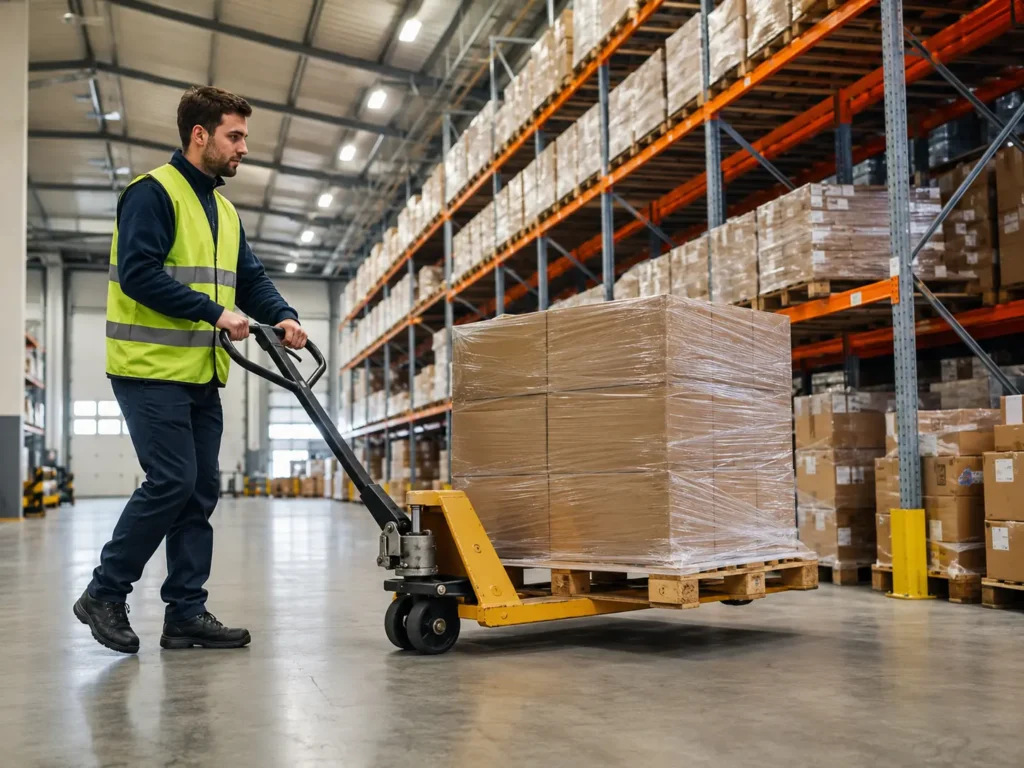
For a manual pallet truck, the basic sequence is to inspect the equipment, confirm the load is within rated capacity, align both forks with the pallet openings, insert the forks fully, raise the pallet only enough to clear the floor, confirm the load is stable, move slowly with clear visibility, take gradual turns, position the pallet accurately at the destination, lower it completely, and remove the forks without placing hands or feet beneath the load.
Warehouse conditions vary, so the operator should also follow the equipment manufacturer’s instructions and site-specific rules. Companies choosing equipment for different pallet dimensions, aisle widths, floor conditions, travel distances, and handling frequencies can contact Akuros for pallet truck selection rather than assuming one configuration will suit every warehouse.
If the truck is damaged → do not use it.
If the load exceeds rated capacity → choose higher-capacity equipment.
If visibility is blocked → stop and change the movement plan.
If the route is wet, obstructed or unsafe → correct the route before moving the load.
What Should You Check Before Using a Pallet Truck?
A pre-use inspection takes only a short time, but it can identify problems before a pallet is raised. The exact inspection should follow the manufacturer and workplace procedure, but the basic principle is consistent: do not discover a mechanical fault while a load is already moving.
Akuros currently offers manual and powered options within its Pallet Truck range, including compact electric units for short-distance internal transfer and a manual model for conventional hand-pallet handling. This illustrates why operators must know which type they are using. A manual hydraulic pallet truck and an electric walkie or stand-on truck have different controls, braking behavior, training considerations, battery systems, and operating risks.
Inspect the Forks
Look along both forks before inserting them into a pallet. Check for obvious bending, cracking, distortion, damaged fork tips, unusual wear, or uneven positioning.
Fork damage matters because the load is supported through the pallet openings. If one fork sits higher, lower, or at a different angle from the other, the load may not be supported evenly.
Check the Wheels and Rollers
Inspect the steer wheels and load rollers for:
- embedded debris;
- flat spots;
- excessive wear;
- cracks or missing material;
- poor rotation;
- objects wrapped around the axle;
- unusual resistance during movement.
Wheel condition affects both operator effort and load stability. A damaged roller can make a manual pallet truck difficult to pull or steer and can create sudden resistance during travel.
For operations that handle pallets repeatedly across larger warehouses, powered equipment may reduce operator effort and improve throughput. Akuros’ guide to electric pallet trucks for small and large warehouses is relevant when travel distance, handling frequency, aisle width, battery strategy, and operator workload make a manual truck less suitable.
Test the Hydraulic System
On a manual truck, operate the handle and confirm that the forks rise normally and lower in a controlled manner. Check beneath the truck for signs of hydraulic leakage.
A truck that lifts slowly, drops unexpectedly, requires unusual pumping force, or fails to hold the load should be removed from service and inspected.
Check the Handle and Controls
The handle should move smoothly and the raise, neutral, and lower functions should work as designed. Powered trucks require additional checks according to the manufacturer’s manual, including controls, emergency features, braking, battery condition, warning devices, and any safety interlocks fitted to the model.
Inspect the Travel Route
The operator should know where the pallet is going before lifting it.
Check for:
- wet or oily flooring;
- debris;
- broken concrete;
- dock edges;
- ramps;
- blind corners;
- narrow aisles;
- pedestrian crossings;
- temporary obstacles;
- insufficient destination clearance.
Load weight also changes the handling decision. Buyers specifying equipment should review the rated capacity rather than buying by truck appearance alone. Akuros’ heavy-duty pallet truck load capacity guide is a useful next step when warehouses regularly handle heavier pallets or need to compare standard and higher-capacity models.
How to Use a Pallet Truck Step by Step
Step 1 — Position the Pallet Truck
Approach the pallet in a straight line whenever possible. Align the forks with the pallet openings before applying force.
Do not approach at a severe angle and attempt to correct alignment while one fork is already inside the pallet. That can damage pallet boards, create uneven loading, and make the pallet harder to pick up cleanly.
Step 2 — Insert the Forks Fully
Push the forks beneath the pallet until the load is properly supported according to the truck and pallet design.
Partial fork insertion is a common mistake because the pallet may appear stable while stationary. The risk appears when the operator turns, crosses an uneven joint, stops suddenly, or encounters resistance. The unsupported portion of the pallet can shift or the load can become unstable.
Common mistake: Never assume that lifting successfully means the load is correctly supported. Fork position should be confirmed before travel begins.
Step 3 — Raise the Pallet
On a manual pallet truck, use the hydraulic handle to raise the forks until the pallet clears the floor sufficiently for travel.
Do not lift unnecessarily high. A pallet truck is designed primarily for horizontal transport, not for carrying loads high above floor level.
Keeping the load low helps reduce unnecessary movement and makes the pallet easier to control.
Step 4 — Check Load Stability
Before moving, stop and look at the pallet.
Ask:
- Is the load centered?
- Are cartons leaning?
- Are straps or stretch film secure?
- Is the pallet damaged?
- Are items protruding into the travel path?
- Is the weight distributed unevenly?
A pallet truck can be mechanically capable of carrying a given weight while the pallet itself remains unsafe to move.
Step 5 — Move the Load Safely
Begin movement gradually. Maintain a controlled walking speed and allow enough distance to stop safely.
Avoid sudden acceleration, jerking, or abrupt changes of direction.
The operator should maintain clear awareness of:
- pedestrians;
- rack legs;
- doors;
- corners;
- other trucks;
- dock edges;
- floor transitions.
Step 6 — Turn Correctly
Reduce speed before turning and use a wide, controlled arc where space allows.
Turning forces can change how the load behaves. A high, unstable, or unevenly distributed pallet becomes more difficult to control when direction changes rapidly.
Never use speed to “swing” a pallet into position.
Step 7 — Position the Pallet at the Destination
Approach the destination slowly and align the pallet before lowering it.
Confirm that:
- the floor or staging location is clear;
- no person’s feet are near the forks;
- the pallet will not block an aisle or emergency route;
- there is enough room to remove the forks.
Step 8 — Lower and Remove the Forks
Lower the pallet fully until the load is supported by the floor or intended surface.
Once the load is stable, remove the forks carefully in a straight line. Do not pull the truck away before the pallet is fully settled.
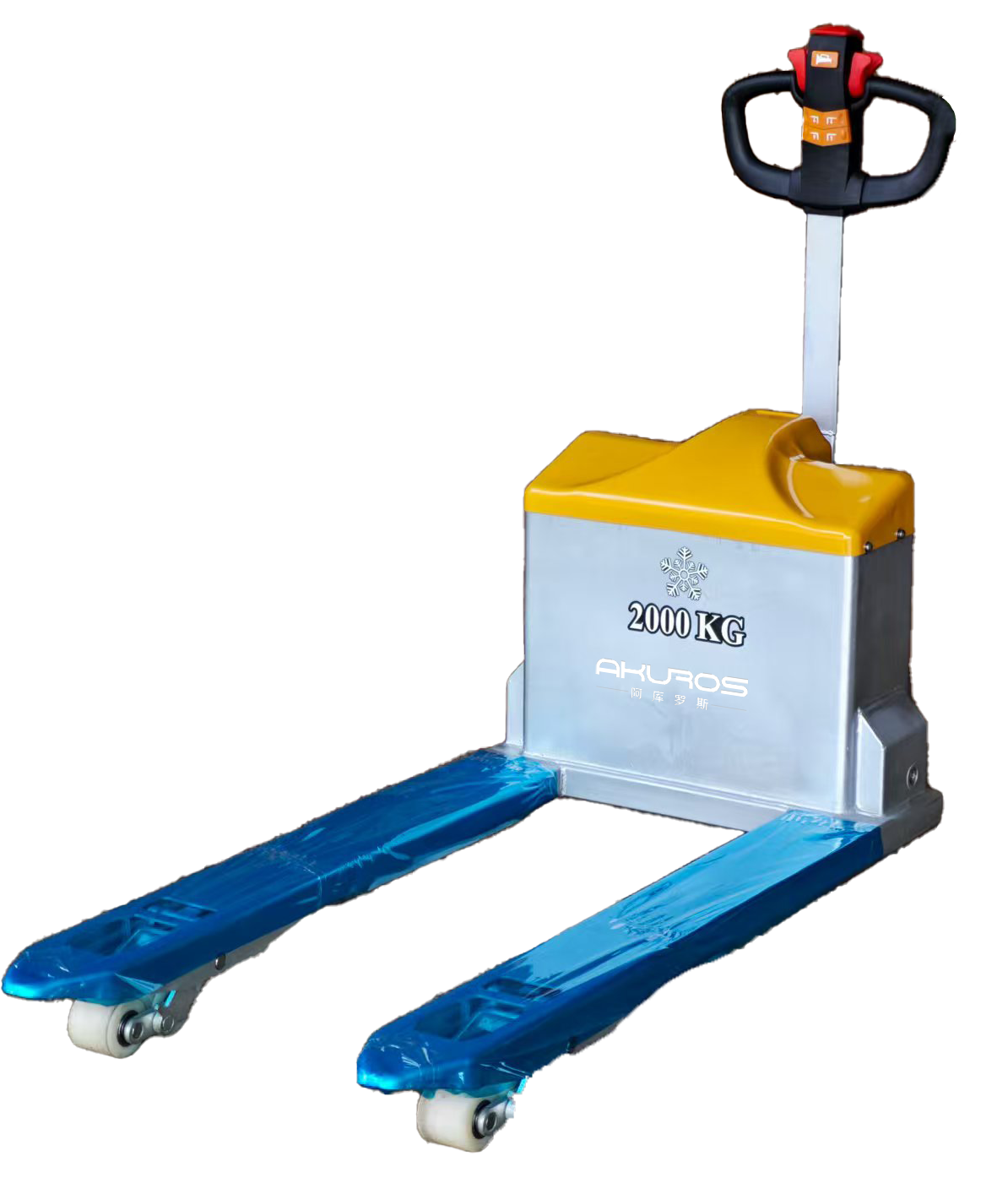
T20B pallet truck
Should You Push or Pull a Manual Pallet Truck?
There is no universal rule that overrides the manufacturer’s instructions or the workplace risk assessment.
The direction of travel should account for:
- visibility;
- load size;
- truck design;
- floor condition;
- operator position;
- pedestrian traffic;
- site rules.
Walking backward while pulling can expose the operator to collisions, trips, doorways, dock edges, racks, or pedestrians that are outside the field of view. Pushing a high load can create a different problem if the pallet blocks forward visibility.
If pulling requires the operator to walk backward without clear visibility → stop and choose a safer movement method.
If pushing places a large load directly between the operator and travel path → visibility must be addressed before movement.
If the manufacturer specifies a preferred operating direction → follow that equipment guidance.
How Much Weight Can a Pallet Truck Carry?
Rated capacity varies by model.
For example, the current Akuros pallet truck range includes published examples around 2.0 tons, 2.2 tons, and a 3.0-ton manual pallet truck. These are model-specific ratings, not a general rule for pallet trucks.
Never determine capacity by looking at fork thickness, wheel size, or whether the truck has moved a similar load before.
| Load Situation | Main Risk | Recommended Action |
|---|---|---|
| Load is below rated capacity and evenly distributed | Normal operating hazards remain | Proceed only after inspection and stability check |
| Load is close to rated capacity | Higher steering and stopping effort | Confirm rating, pallet condition, route and floor condition carefully |
| Load exceeds rated capacity | Equipment damage, poor control, load instability | Use equipment with an appropriate rated capacity |
| Weight is unknown | Operator cannot confirm safe capacity | Determine load weight before movement |
| Load is highly uneven | Unstable support and difficult steering | Reconfigure or secure the load before moving |
Why Load Distribution Matters
A 1,000 kg load distributed evenly across a stable pallet is not the same handling problem as 1,000 kg concentrated heavily at one end.
Uneven loads can:
- change steering effort;
- increase pallet damage;
- increase the risk of load movement;
- place unusual forces on the forks and rollers.
The operator should never attempt to “balance” an obviously unstable pallet by moving faster or holding the handle differently. Correct the load first.
How to Handle a Pallet Truck on Slopes and Uneven Floors
Uneven Warehouse Floors
Cracks, expansion joints, broken concrete, thresholds, and debris can create sudden rolling resistance.
Reduce speed and keep the load low. Avoid making sharp turns while the wheels are crossing uneven sections.
The UK Health and Safety Executive has documented that manual pallet-truck pushing and pulling becomes more difficult on uneven floors and that equipment selection should match the surface condition.
Ramps and Slopes
Do not improvise on ramps.
A loaded pallet has gravitational force acting downhill, which can make a manual truck difficult or impossible to control safely. Powered trucks also have manufacturer-specific gradeability and braking limits.
Follow:
- the manufacturer’s instructions;
- site procedures;
- local safety requirements;
- the truck’s rated operating conditions.
If the operator is unsure whether the truck can safely control the pallet on a slope → do not attempt the movement.
Wet or Contaminated Floors
Water, oil, packaging film, loose stretch wrap, cardboard, or granular debris can reduce traction and create slip or wheel-control problems.
Stop the operation and clear the route before continuing.
Pallet Truck Safety Checklist
| Stage | Check | Reason |
|---|---|---|
| Before Use | Fork condition | Damaged forks can affect safe load support |
| Before Use | Wheels and rollers | Wear or debris can increase rolling resistance |
| Before Use | Hydraulic system | Leaks or poor lift response require inspection |
| Before Use | Rated capacity | Truck must be suitable for the actual load |
| Before Use | Pallet condition | Broken pallets can fail during movement |
| Before Use | Travel route | Obstacles, slopes and pedestrians change risk |
| During Movement | Load remains low | Improves control |
| During Movement | Clear visibility | Reduces collision risk |
| During Movement | Controlled speed | Allows smoother stopping and turning |
| At Destination | Clear placement zone | Protects pedestrians and surrounding equipment |
| After Use | Forks fully lowered | Reduces trip and impact hazards |
| After Use | Correct parking location | Keeps aisles and emergency routes clear |
10 Common Pallet Truck Mistakes
1. Overloading the Truck
Mistake: Moving a load above the truck’s rated capacity.
Consequence: Reduced control, equipment damage, increased stopping difficulty, and potential load instability.
Better practice: Verify weight and use correctly rated equipment.
2. Partially Inserting the Forks
Mistake: Lifting the pallet while only part of the forks supports it.
Consequence: Poor load support and increased pallet damage or movement.
Better practice: Align correctly and insert the forks to the proper position before lifting.
3. Lifting the Load Too High
Mistake: Raising the pallet substantially more than required for horizontal travel.
Consequence: Unnecessary movement and reduced stability.
Better practice: Lift only enough to obtain safe floor clearance.
4. Turning Too Quickly
Mistake: Making a sharp turn at normal walking speed.
Consequence: The load may shift and the operator can lose control.
Better practice: Slow before the turn and steer gradually.
5. Moving With Blocked Visibility
Mistake: Continuing forward when the load hides pedestrians or obstacles.
Consequence: Collision risk increases significantly.
Better practice: Stop and change the operating method or route.
6. Using a Damaged Pallet
Mistake: Moving broken boards, loose blocks, missing fasteners, or unstable loads.
Consequence: The pallet can fail while moving.
Better practice: Re-palletize or repair according to workplace procedures before transport.
7. Ignoring Floor Conditions
Mistake: Treating every aisle as equally suitable.
Consequence: Wet, uneven or contaminated surfaces can create sudden resistance and loss of control.
Better practice: Inspect the route and correct hazards first.
8. Putting Hands or Feet Near the Forks
Mistake: Reaching under a load or standing with feet beneath or immediately beside descending forks.
Consequence: Crushing and pinch-point injuries can occur.
Better practice: Keep body parts clear of the load and lifting mechanism.
9. Allowing People to Ride on the Pallet Truck
Mistake: Treating a conventional pallet truck as passenger equipment.
Consequence: Falls, collisions and loss of control.
Better practice: Use the equipment only as designed by the manufacturer.
10. Leaving Raised Forks in a Traffic Area
Mistake: Parking with forks raised or protruding into walkways.
Consequence: Trip, impact and vehicle hazards.
Better practice: Lower forks fully and use a designated parking area.
Manual vs Electric Pallet Truck: Does Operation Differ?
Yes. The underlying pallet-handling principles are similar, but propulsion, controls, braking, operator effort, maintenance, and regulatory requirements can differ substantially.
| Factor | Manual Pallet Truck | Electric Pallet Truck |
|---|---|---|
| Propulsion | Operator pushing or pulling | Electric motor |
| Fork lifting | Manual hydraulic pumping | Powered or electro-hydraulic depending on model |
| Typical travel | Short distances | Better suited to frequent or longer internal travel |
| Operator effort | Higher physical effort | Reduced propulsion effort |
| Controls | Simple handle functions | Travel, braking and lift controls vary by model |
| Battery | None | Lithium or lead-acid systems may be used |
| US OSHA PIT training | Manual trucks are not powered industrial trucks under 1910.178 | Powered pallet trucks fall within powered industrial truck requirements |
| Best fit | Lower-volume, short-distance movement | Higher-frequency operations and longer travel |
If movement is occasional and travel distance is short → a manual pallet truck may be the simpler choice.
If operators move pallets repeatedly across larger distances → evaluate an electric pallet truck.
If high throughput is required → compare travel speed, battery strategy, ergonomics, charging and service requirements.
What Training Does a Pallet Truck Operator Need?
Training should match both the equipment and the workplace.
For manual pallet trucks, employers should establish safe procedures based on workplace risk, manufacturer instructions, applicable local requirements, load conditions, pedestrian traffic, and floor design.
For powered pallet trucks in the United States, the regulatory situation is more specific. OSHA 29 CFR 1910.178 covers powered industrial trucks, including motorized hand trucks, and requires employers to ensure operators are competent through training and evaluation.
OSHA Training for Powered Pallet Trucks
For powered industrial trucks, OSHA requires training that includes:
- formal instruction;
- practical training;
- workplace evaluation;
- equipment-specific topics;
- workplace hazards;
- refresher training when required.
OSHA also requires periodic operator evaluation at least once every three years for powered industrial trucks.
Important distinction: Do not describe every manual pallet truck as requiring OSHA powered-industrial-truck certification. The federal 1910.178 training rules apply to powered equipment within the standard’s scope. Local regulations and employer policies may impose additional requirements.
What PPE Should Be Used?
PPE should be selected through the workplace hazard assessment rather than copied from a generic internet list.
Depending on the operation, this may include:
- safety footwear;
- high-visibility clothing;
- appropriate gloves;
- additional site-specific protection.
PPE does not replace proper equipment selection, traffic management, safe floors, operator training, or correct load handling.
Steel-toe footwear cannot compensate for an overloaded pallet, and high-visibility clothing cannot compensate for a blind corner with no pedestrian control.
How to Park and Store a Pallet Truck Correctly
At the end of use:
- Position the truck in its assigned area.
- Lower the forks completely.
- Do not block pedestrian aisles.
- Do not block fire exits.
- Do not leave the truck in front of doors.
- Keep loading and staging lanes clear.
- Report any damage discovered during operation.
Powered trucks should also be shut down, charged, or parked according to the manufacturer’s procedure and workplace rules.
When Should a Pallet Truck Be Removed From Service?
Operators should not continue working with equipment simply because it can still move.
Warning signs include:
- hydraulic leakage;
- bent or cracked forks;
- damaged load rollers;
- steering problems;
- abnormal noises;
- poor lifting response;
- uncontrolled lowering;
- handle or control malfunction;
- damaged electric controls;
- braking problems on powered equipment;
- visible battery damage on electric models.
If damage could affect safe operation → stop using the truck → identify or tag the equipment according to site procedure → report the defect → arrange inspection or repair.
How Warehouse Managers Can Reduce Pallet Truck Incidents
Operator behavior matters, but good warehouse systems reduce the number of difficult decisions an operator has to make.
Standardize Pre-Use Inspection
Use one consistent checklist for each equipment category so operators know exactly what to inspect.
Separate Pedestrians and Equipment
Where possible, warehouse design should distinguish:
- pedestrian routes;
- pallet movement routes;
- crossing points;
- staging areas;
- parking zones.
Maintain Floors
Small floor defects can significantly affect small-diameter pallet truck rollers.
Repair:
- broken concrete;
- large gaps;
- damaged dock plates;
- persistent wet zones;
- floor transitions that repeatedly cause handling difficulty.
Match Equipment to the Workflow
A manual truck may work perfectly in a compact warehouse moving six pallets per shift. The same equipment may be inefficient and physically demanding in a distribution center moving hundreds of pallets over longer distances.
Equipment selection should therefore consider:
- daily pallet volume;
- average travel distance;
- maximum pallet weight;
- aisle width;
- pallet dimensions;
- floor quality;
- number of operating shifts;
- charging opportunities;
- maintenance resources.
Pallet Truck Operating Decision Guide
| Situation | Recommended Action | Reason |
|---|---|---|
| Blocked visibility | Stop and change route or operating method | Operator must be able to manage collision risk |
| Damaged pallet | Do not move until load is made safe | Pallet integrity is part of load stability |
| Over-capacity load | Use higher-capacity equipment | Rated limits should not be exceeded |
| Uneven floor | Reduce speed, reroute or choose suitable equipment | Rolling resistance and stability change |
| Hydraulic fault | Remove truck from service | Lift and lowering control may be compromised |
| Frequent long-distance travel | Evaluate electric pallet truck | Can reduce operator effort and improve throughput |
| Narrow aisle | Confirm turning radius and truck dimensions | Truck must suit available maneuvering space |
| Cold storage | Verify equipment is specified for the environment | Temperature can affect batteries, materials and controls |
How to Choose the Right Pallet Truck for a Warehouse
Correct operation becomes much easier when the equipment suits the job.
Check Rated Capacity
Identify the maximum normal load and any occasional heavier pallets. Do not purchase a truck that forces operators to work at or above capacity during routine operation.
Confirm Fork Dimensions
Fork width, spacing and length need to suit the pallet types used in the warehouse.
Common systems may include:
- Euro pallets;
- CHEP pallets;
- industrial pallets;
- custom production pallets.
Evaluate Wheel Material
Wheel material affects:
- noise;
- rolling resistance;
- floor protection;
- wear;
- performance over joints and debris.
Measure Travel Distance
A manual pallet truck that feels efficient over 10 metres may become a poor ergonomic choice when an operator repeats a 100-metre route all day.
Consider Daily Handling Frequency
A warehouse moving 20 pallets per day has different equipment economics from one moving 500.
Review Maintenance and Service
Compare:
- replacement wheels;
- hydraulic components;
- battery support;
- charger availability;
- spare parts;
- service network;
- maintenance intervals.
Manual Pallet Truck vs Electric Pallet Truck: Buyer Recommendation
| Warehouse Condition | Recommended Direction |
|---|---|
| Low daily pallet volume | Manual pallet truck may be sufficient |
| Very short travel distance | Manual pallet truck can remain efficient |
| Frequent repetitive movement | Evaluate electric pallet truck |
| Long warehouse travel routes | Powered equipment is usually worth evaluating |
| Heavier routine loads | Choose capacity based on verified load requirements |
| Narrow congested aisles | Prioritize maneuverability and dimensions |
| Multi-shift operation | Evaluate battery and charging strategy |
| Uneven surfaces | Choose equipment and wheels suited to the floor |
 |
 |
Frequently Asked Questions
1. How do beginners use a pallet truck safely?
Beginners should start by reading the manufacturer instructions and receiving the workplace training required for the specific equipment and site. Before moving a pallet, inspect the forks, wheels, rollers, hydraulic system, handle or controls, pallet condition, load weight, and travel route. Align the forks with the pallet openings, insert them correctly, lift only enough to clear the floor, confirm the load is stable, and move at a controlled speed. Keep clear visibility, slow down before turns, keep hands and feet away from the lifting mechanism, and lower the pallet completely before removing the forks. Powered pallet trucks may also be subject to specific operator training and evaluation requirements.
2. Should you push or pull a manual pallet truck?
There is no single push-or-pull rule that should override the truck manufacturer’s instructions, workplace procedure, load visibility, and route conditions. Pulling may allow good control in some level-floor situations, but walking backward without a clear view creates trip and collision hazards. Pushing can create a different problem if a tall pallet blocks the operator’s forward visibility. Operators should use the method approved for their equipment and workplace, maintain visibility, avoid uncontrolled backward walking, and stop whenever the load or route prevents safe movement.
3. How high should a pallet truck lift a pallet?
A pallet truck should normally lift the pallet only enough to provide adequate floor clearance for safe horizontal travel. Raising the load unnecessarily high does not improve transport efficiency and can make movement less stable. The exact lift range depends on the truck model; pallet trucks are generally designed for low-level pallet transport rather than high stacking. Operators should follow the equipment manufacturer’s instructions and verify that the pallet clears floor joints, ramps, or minor transitions without raising it beyond what is needed for normal travel.
4. Can you use a pallet truck on a slope?
Use on slopes requires particular caution and should be permitted only when the equipment manufacturer, site procedure, and applicable safety requirements allow it. A loaded pallet creates downhill force that can make a manual truck difficult to control, while powered pallet trucks have model-specific braking and gradeability limits. Operators should never improvise by attempting to hold back an excessively heavy load using body force. If the route includes a slope and the operator cannot confirm that the truck is suitable for that condition, stop and use an approved route or suitable handling equipment.
5. What should you check before using a pallet truck?
A pre-use inspection should include the forks, fork tips, wheels, load rollers, hydraulic system, handle, raise-and-lower functions, and any visible damage. Powered pallet trucks require additional checks according to the manufacturer, such as travel controls, braking, emergency functions, warning devices, battery condition, and safety interlocks. The operator should also inspect the pallet and load, confirm the weight is within rated capacity, and check the route for wet floors, debris, slopes, blind corners, pedestrians, dock edges, or insufficient destination clearance. Any defect that could affect safe operation should be reported before the equipment is used.
References
- Powered Industrial Trucks, 29 CFR 1910.178 — Occupational Safety and Health Administration — U.S. Department of Labor — General Industry Safety Standard.
- Powered Industrial Trucks: Training Assistance — Occupational Safety and Health Administration — U.S. Department of Labor — OSHA Powered Industrial Trucks eTool.
- Sample Daily Checklists for Powered Industrial Trucks — Occupational Safety and Health Administration and Industrial Truck Association — U.S. Department of Labor — OSHA Operator Training Resources.
- Materials Handling and Storage, OSHA Publication 2236 — Occupational Safety and Health Administration — U.S. Department of Labor — Materials Handling Safety Guidance.
- Powered Industrial Truck Operator Training for General Industry — Occupational Safety and Health Administration — U.S. Department of Labor — Operator Training Information Card.
- Manual Handling at Work: Avoid Hazardous Manual Handling — Health and Safety Executive — UK HSE — Manual Handling and Mechanical Aid Guidance.
- Manual Pallet Trucks, Construction Occupational Health Case Study COH06 — Health and Safety Executive — UK HSE — Pallet Truck and Uneven Floor Case Study.
- Powered Industrial Trucks: Loading and Unloading — Occupational Safety and Health Administration — U.S. Department of Labor — Warehouse and Material Handling Safety Resources.
How to Turn Safe Pallet Truck Operation Into a Repeatable Warehouse System
What Is the Most Important Rule When Using a Pallet Truck?
The most important rule is to avoid beginning the movement until the truck, pallet, load, route, and operator are all ready. Safe pallet handling is not created by one perfect steering technique. It comes from a sequence of small controls: inspecting equipment, confirming capacity, stabilizing the load, selecting a safe route, maintaining visibility, traveling at a controlled speed, and stopping when conditions change.
Why Does Equipment Selection Affect Safety?
A pallet truck that is technically functional can still be poorly matched to the warehouse. Excessively heavy loads, long travel distances, narrow aisles, uneven flooring, non-standard pallets, high daily throughput, and cold-storage environments can all change which truck is appropriate. A manual truck may be ideal for short occasional transfers while an electric pallet truck can reduce physical effort and improve throughput in repetitive operations. Choosing the right equipment removes pressure on operators to compensate for an unsuitable machine.
How Should Buyers Compare Manual and Electric Options?
| Operational Requirement | Direction to Evaluate |
|---|---|
| Occasional short-distance pallet movement | Manual pallet truck |
| Frequent repetitive transport | Electric pallet truck |
| Long internal travel routes | Electric or ride-on/stand-on powered options |
| Very heavy loads | Verify dedicated higher-capacity model |
| Restricted aisle space | Compact truck with suitable turning radius |
| Uneven floor | Evaluate wheel design and equipment suitability |
| Multi-shift warehouse | Evaluate battery type, charging and duty cycle |
What Should Warehouse Managers Standardize?
Warehouse managers should standardize pre-use inspections, defect reporting, operator training, route design, pedestrian separation, parking zones, pallet quality checks, maintenance intervals, and equipment selection criteria. Standardization reduces the number of safety decisions that workers have to invent during a busy shift. It also makes abnormal conditions easier to recognize because operators know what normal equipment and workflow should look like.
The Buyer Mistake Most Often Underestimated
A common purchasing mistake is choosing pallet trucks only by rated capacity. Capacity is important, but a 2-ton truck can still be the wrong choice if the forks do not fit the pallet, the turning radius conflicts with the aisle, the wheels perform poorly on the floor, or manual propulsion creates excessive operator effort over long routes. A better specification combines capacity with pallet dimensions, travel distance, daily handling frequency, aisle width, floor condition, ergonomics, battery strategy where applicable, and after-sales service.
What Is Changing in Warehouse Pallet Handling?
Warehouses are gradually shifting from isolated equipment purchases toward workflow-based material handling. Electric pallet trucks, lithium battery systems, warning devices, digital fleet management, automation, standardized traffic routes, and ergonomic design are becoming part of the same operational discussion. The goal is no longer simply to move a pallet from A to B. The goal is to reduce travel time, operator strain, equipment downtime, pedestrian interaction, and inconsistent handling across shifts.
Recommended Decision Logic
If pallet movement is occasional, loads are moderate, and travel distances are short, a manual truck may remain the most economical solution. If operators repeatedly move pallets over longer distances, compare powered options. If loads are heavy, determine actual weight before selecting equipment. If the floor is poor, correct the route or choose a truck designed for those conditions. If equipment is damaged, remove it from service. If visibility is blocked, stop and change the movement plan rather than relying on operator skill to compensate for an unsafe condition.
Final Recommendation
A Pallet Truck should be treated as part of the warehouse operating system rather than a simple set of forks and wheels. Correct operation begins with inspection and ends with proper parking, but performance also depends on layout, traffic management, pallet quality, floor condition, operator competence, and equipment selection. Warehouses that standardize these factors usually create a safer and more predictable material-handling process than those that rely only on operator experience.
Before purchasing a new pallet truck, prepare the maximum load weight, pallet dimensions, typical travel distance, daily pallet volume, aisle width, floor condition, number of shifts, charging requirements for electric equipment, and required service support. Comparing those operating conditions against the truck specification is far more useful than choosing solely by price or rated capacity.
Move the Pallet Only When the Whole Route Is Ready
Correct pallet truck operation is not difficult to understand, but consistency matters. Inspect the truck, confirm the pallet and load are stable, match the equipment to the rated load, insert the forks correctly, lift only enough for safe travel, maintain visibility, control speed, turn gradually, lower the pallet fully, and report defects immediately.
The most expensive warehouse handling mistake is often not equipment failure. It is continuing the task when the operator already knows that something is wrong.
If the floor is unsafe, stop. If the pallet is broken, stop. If the load is too heavy, stop. If the truck is damaged, stop. If the operator cannot see the route, stop.
That simple decision discipline is what turns basic pallet movement into professional warehouse handling.