


Electric Pallet Trucks are now one of the most practical handling solutions for warehouses that need faster pallet movement without investing in large counterbalance forklifts for every task. In a small warehouse, an electric pallet truck can help operators move goods through narrow aisles, loading bays, retail storage rooms, and workshop areas with less physical strain. In a large warehouse, it can support repetitive pallet transfer between receiving zones, production lines, racking areas, dispatch docks, and staging lanes.
The buying decision is not only about choosing a powered truck instead of a manual truck. Buyers must compare capacity, battery voltage, fork height, pallet compatibility, operator position, safety controls, turning radius, cold storage capability, maintenance cost, and long-term productivity. A low-cost model may be enough for light daily transfer, while a higher-capacity electric pallet truck may be necessary for heavy pallets, frequent loading, multi-shift operation, or cold-chain logistics.
For buyers building a product comparison list, the Electric Pallet Trucks product range from Akuros provides a useful starting point because it includes compact walkie electric pallet trucks, stand-on electric pallet trucks, cold storage pallet truck options, and manual alternatives for different warehouse workloads.
Electric Pallet Trucks
What Are Electric Pallet Trucks?
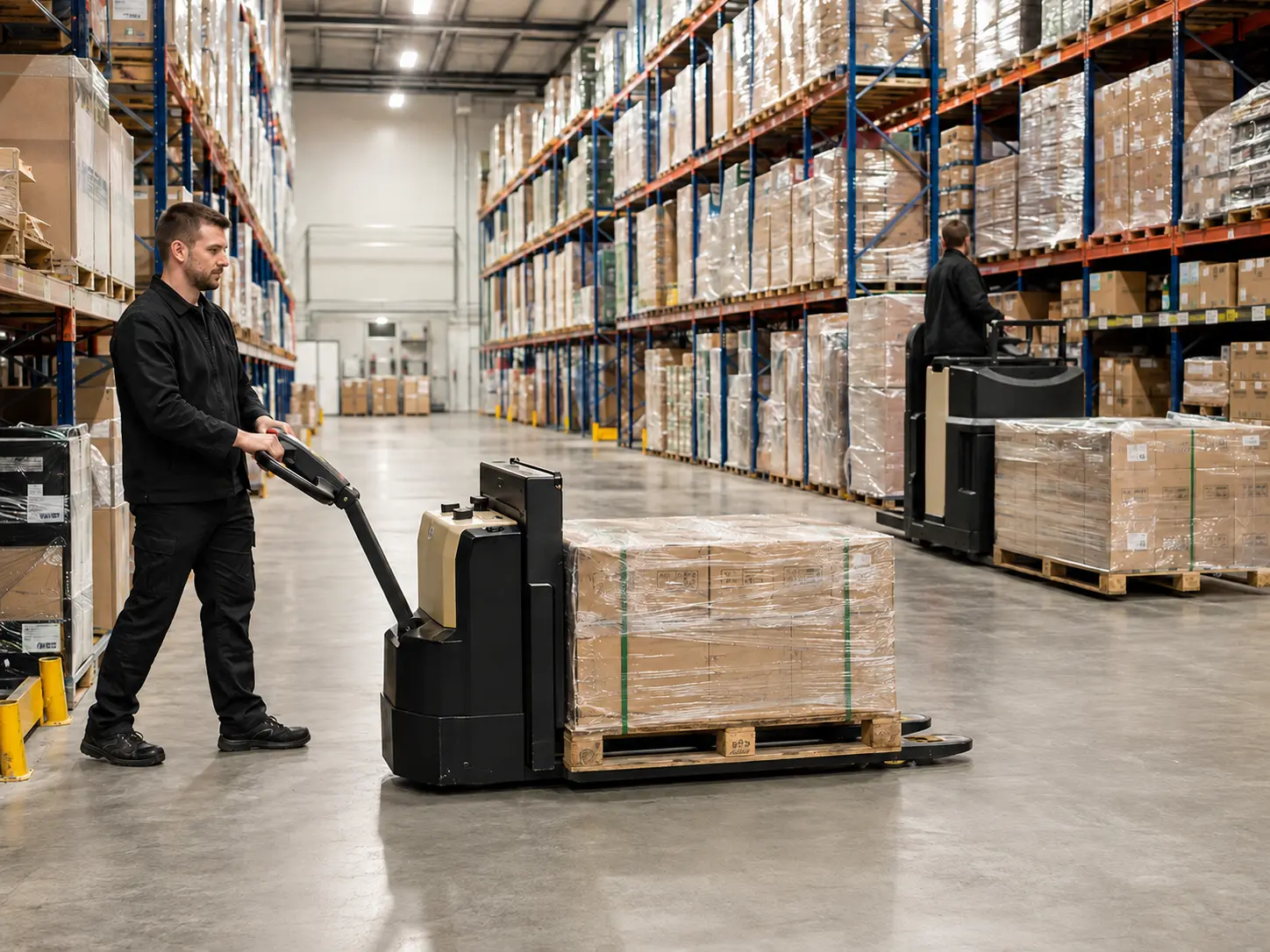
Electric Pallet Trucks are powered material handling vehicles designed to lift and move palletized loads over short to medium distances. Unlike manual pallet trucks, they use an electric drive system to reduce pushing and pulling effort. Unlike larger forklifts, they are compact, easier to operate in tight spaces, and especially suitable for horizontal transport rather than high lifting.
In real warehouse operations, this equipment is often used for unloading trucks, moving pallets from receiving to storage, transferring finished goods from production lines, feeding packing areas, replenishing stock, and positioning pallets before forklift storage. Because the truck travels at controlled speeds and lifts pallets only to a low height, it is efficient for ground-level movement, dock work, and repetitive internal transfer.
Search demand around electric pallet truck for warehouse, walkie electric pallet truck, stand-on electric pallet truck, electric pallet truck manufacturer, China electric pallet truck factory, and wholesale electric pallet trucks is increasing because more buyers want equipment that can reduce labor intensity while improving daily handling efficiency.
Why Warehouses Are Upgrading From Manual Handling
Lower Operator Fatigue
Manual pallet movement may look simple, but repeated pulling, turning, stopping, and positioning can create heavy physical demand. In busy warehouses, operators may move dozens or hundreds of pallets in one shift. Electric drive reduces the effort required to start movement, travel with a load, and maneuver around aisles or dock doors. This improves consistency and helps reduce fatigue-related handling mistakes.
Better Productivity in Repetitive Routes
Many warehouses have fixed routes: receiving dock to inspection area, storage area to packing line, production line to finished goods zone, cold room to dispatch area, or supermarket backroom to sales floor. When these movements are repeated every day, powered pallet trucks can reduce cycle time and support more stable workflows.
Cleaner Indoor Operation
Because electric pallet trucks do not use combustion engines, they are suitable for indoor warehouses, food logistics, retail storage areas, pharmaceutical handling zones, production workshops, and enclosed distribution centers. Lower noise and cleaner operation are important in places where workers, goods, and equipment share the same space.
Small Warehouse vs Large Warehouse: Different Buying Logic
A small warehouse usually needs compact size, easy turning, simple charging, and flexible daily use. The main pain point is limited space. A large warehouse usually needs higher travel efficiency, stronger battery configuration, better uptime, operator comfort, and fleet consistency. The main pain point is handling volume.
| Warehouse Type | Main Handling Problem | Recommended Truck Type | Buyer Priority |
|---|---|---|---|
| Small warehouse | Narrow aisles, limited turning space, mixed pallet movement | Compact walkie electric pallet truck | Maneuverability, easy operation, low maintenance |
| Medium warehouse | Frequent receiving, stock transfer, loading dock work | 2.0-ton to 2.2-ton electric pallet truck | Capacity, battery life, fork compatibility |
| Large distribution center | Longer travel routes and higher daily pallet volume | Stand-on electric pallet truck | Travel efficiency, operator comfort, shift productivity |
| Cold storage warehouse | Low temperature, wet floors, condensation, slippery surfaces | Cold storage electric pallet truck | Waterproof control, cold-resistant parts, traction |
| Low-frequency warehouse | Occasional pallet movement and limited equipment budget | Manual pallet truck or entry-level electric model | Purchase cost, reliability, simple maintenance |
Top Rated Electric Pallet Truck Types for Warehouse Buyers
Walkie Electric Pallet Trucks for Daily Pallet Transfer
Walkie Electric Pallet Trucks are controlled by an operator walking behind or beside the truck. They are suitable for short-distance pallet movement, loading areas, workshops, narrow aisles, and standard warehouse transfer. This type is usually easier to introduce into small and medium warehouse operations because the body is compact and the learning curve is lower.
A walkie model is often the best choice when operators need to move pallets frequently but do not need long travel speeds or a standing platform. If your team is replacing manual handling and wants a practical first step into powered equipment, a walkie truck is usually easier to justify.
Stand-On Electric Pallet Trucks for Higher Throughput
Stand-on models are designed for faster internal movement, longer routes, and higher pallet turnover. The operator stands on a platform while driving, which can improve productivity when pallets need to be moved repeatedly across wider warehouse zones. For logistics hubs, distribution centers, and larger facilities, stand-on operation helps reduce walking distance and operator fatigue.
For buyers comparing a high-volume option, the T20 stand-on electric pallet truck is relevant for operations that need a 2.0-ton capacity configuration, stronger working cycles, and practical battery options for daily warehouse movement.
Cold Storage Electric Pallet Trucks for Refrigerated Logistics
Cold storage warehouses create different equipment challenges. Low temperatures affect batteries, electronics, handles, wheels, lubrication, and operator comfort. Wet or frozen floors increase slip risk. Condensation can damage unsuitable electrical components. This means a normal indoor pallet truck may not be enough for refrigerated warehouses, frozen food logistics, seafood storage, dairy distribution, or food processing areas.
Buyers operating in refrigerated environments should compare waterproof design, low-temperature control components, galvanized or corrosion-resistant structures, stainless bearing components, traction wheel design, and low-speed safety control. For this type of site, a cold storage electric pallet truck can help reduce handling risk while improving reliability in demanding temperature and humidity conditions.
Higher-Capacity Electric Pallet Trucks for Heavy Loads
Warehouses handling beverages, building materials, frozen goods, industrial components, paper products, packaged chemicals, and dense palletized cargo often need stronger capacity. A standard 1.5-ton or 2.0-ton truck may not provide enough margin when pallets are heavy or unevenly loaded. In these cases, capacity should be selected with a safety buffer, not just based on average pallet weight.
For buyers who move heavier pallets in cold-chain, workshop, receiving, and dispatch environments, the T22B electric pallet truck is a useful comparison model because it supports a 2.2-ton load direction, compact walking-style operation, and warehouse use where traction, low fork height, and stable control are important.
Manual Pallet Trucks for Backup and Low-Cost Handling
Electric models are not the only answer for every warehouse. A manual truck is still useful as a backup unit, a low-frequency handling tool, or a cost-effective solution for very short moves. It does not require charging, battery replacement, or electrical maintenance, which makes it practical for small stores, simple warehouses, workshops, and emergency use.
For buyers comparing powered and manual solutions, the M30 hand pallet truck shows why a 3.0-ton manual option can still be valuable when the main requirement is simple, dependable, low-cost pallet movement without electric power.
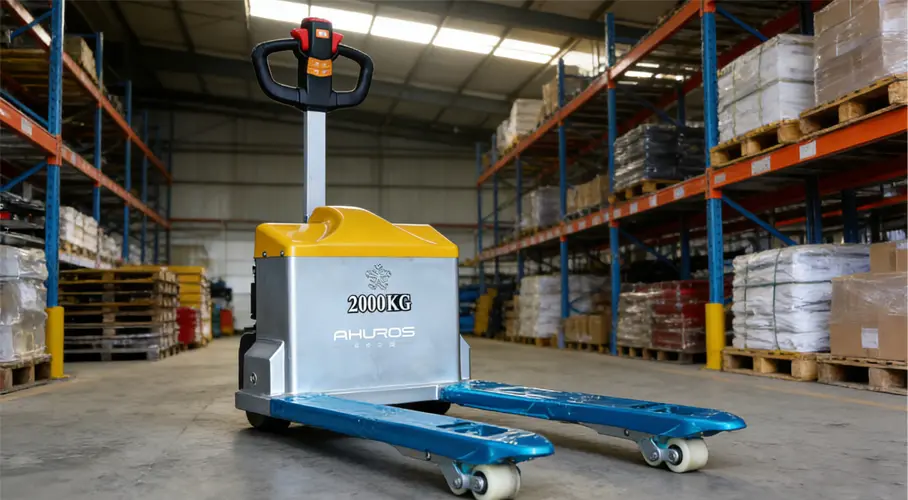
T20B Electric Pallet Truck
Key Technical Parameters Buyers Should Compare
A good pallet truck selection should start with numbers. Buyers should not only compare price and appearance. Load capacity, battery voltage, battery capacity, lift height, lowered fork height, fork width, travel speed, wheel material, gradeability, turning radius, braking system, and controller design all affect how well the truck performs in real operation.
| Parameter | Typical Buyer Question | Why It Matters | Decision Tip |
|---|---|---|---|
| Load capacity | Can the truck handle our heaviest pallet safely? | Undersized capacity increases stress and safety risk. | Select above average pallet weight, not equal to it. |
| Battery voltage | Is the power system enough for daily handling intensity? | Voltage affects drive performance and working stability. | Match voltage and battery capacity to route distance and shift length. |
| Battery capacity | How long can the truck operate between charging? | Low capacity may cause downtime during peak hours. | Consider multi-shift demand, charging time, and backup planning. |
| Lift height | Can the forks lift pallets enough for smooth transfer? | Insufficient lift height can cause dragging or floor contact. | Check pallet type, floor condition, and dock operation. |
| Lowered fork height | Can the fork enter our pallets easily? | Wrong fork height causes handling delays. | Confirm pallet opening height before ordering. |
| Fork width | Does the truck match Euro pallets, industrial pallets, or custom pallets? | Wrong fork width reduces compatibility. | Match truck configuration to your most common pallet type. |
| Wheel material | Will the wheel work on smooth, wet, cold, or rough floors? | Poor wheel selection affects traction and control. | Choose wheel material according to floor condition. |
| Turning radius | Can operators turn inside aisles and dock zones? | Large turning radius slows tight-space movement. | Measure real aisle width before selecting a model. |
Battery Selection: Lead-Acid, Lithium, and Shift Planning
Battery selection is one of the most important buying decisions for Electric Pallet Trucks. The right battery is not simply the biggest battery. It must match the warehouse shift pattern, charging area, charging time, operator habits, and daily handling frequency.
Lead-Acid Battery Considerations
Lead-acid batteries are common and cost-effective, but they need more maintenance attention. Buyers should consider charging time, ventilation, battery care, and replacement planning. They may be practical for single-shift warehouses with predictable charging windows.
Lithium Battery Considerations
Lithium batteries are often preferred for opportunity charging, lower maintenance, and more flexible daily operation. For warehouses with multiple shifts or frequent short breaks, lithium charging can reduce downtime. However, buyers should still compare charger compatibility, battery management system quality, replacement cost, and safe charging procedures.
| Battery Type | Advantages | Buyer Risk | Best Use |
|---|---|---|---|
| Lead-acid battery | Lower initial cost and mature technology | Longer charging time and more maintenance | Single-shift or moderate-use warehouses |
| Lithium battery | Opportunity charging and lower maintenance | Higher initial purchase cost | Multi-shift warehouses and high-frequency pallet movement |
| Manual power | No battery, no charger, low operating complexity | Higher operator effort and lower productivity | Backup use, low-frequency handling, small storage areas |
Safety, Regulations, and Compliance Considerations
Material handling equipment must be selected and operated with safety in mind. Buyers should consider operator training, load stability, braking performance, emergency stop function, speed control, reverse protection, horn, visibility, pedestrian routes, floor condition, and warehouse traffic management. Even compact electric pallet trucks can cause injuries or product damage if operators are not trained or if traffic routes are poorly planned.
In many markets, employers are expected to provide safe equipment, maintain handling vehicles properly, train operators, inspect working conditions, and control risks around pedestrians and loading docks. For warehouse managers, this means that buying equipment is only one part of the decision. Daily inspection checklists, charging rules, aisle marking, load limits, and maintenance schedules should also be part of the implementation plan.
| Risk Area | Common Problem | Possible Consequence | Recommended Control |
|---|---|---|---|
| Overloading | Truck is used above rated capacity | Loss of control, component damage, unsafe braking | Train operators and mark load limits clearly. |
| Wet floor | Truck slips during turning or stopping | Product damage or operator injury | Use suitable wheels and improve floor management. |
| Battery charging | Unsafe charging area or poor charging habits | Battery damage, downtime, safety hazards | Create charging rules and use compatible chargers. |
| Pedestrian traffic | Shared routes without separation | Collision risk | Mark lanes, train operators, and control speed. |
| Pallet mismatch | Forks do not enter pallets smoothly | Delays, unstable loads, pallet damage | Confirm pallet type and fork dimensions before purchase. |
Common Mistakes When Buying Electric Pallet Trucks
Choosing Only by Price
The cheapest truck may become expensive if it cannot handle the real workload. Buyers should calculate downtime, battery replacement, operator efficiency, damage reduction, maintenance cost, and expected service life. For B2B buyers, total cost of ownership is more important than unit price alone.
Ignoring Real Pallet Weight
Some buyers choose capacity based on average load weight. This is risky because the heaviest pallet, not the average pallet, determines whether the truck is suitable. If your average pallet is 1,200 kg but peak pallets reach 2,000 kg, a low-capacity truck may not be safe or efficient.
Forgetting Floor and Wheel Conditions
A truck that works well on smooth dry concrete may not perform the same way on wet loading docks, cold storage floors, sloped entrances, rough factory floors, or outdoor transition zones. Wheel selection, traction, and braking control should match the environment.
Not Planning Charging and Uptime
A battery-powered truck must fit the warehouse schedule. If charging is not planned, the truck may stop during peak receiving or dispatch periods. Buyers should calculate operating hours, break-time charging, spare battery needs, charger location, and operator responsibility.
How to Select a Reliable Electric Pallet Truck Supplier
A reliable supplier should help buyers match the truck to actual warehouse conditions rather than simply selling a model. Buyers should share pallet weight, pallet size, aisle width, floor condition, working temperature, daily travel distance, shift hours, loading dock layout, and application photos. A strong supplier can then recommend the proper capacity, battery system, fork size, wheel configuration, and safety options.
For companies comparing an Electric Pallet Trucks manufacturer, Akuros is positioned around warehousing and logistics solutions, including material handling equipment, warehouse planning, logistics consulting, equipment sales, leasing support, and service-oriented project communication.
| Supplier Evaluation Item | Good Signal | Risk Signal |
|---|---|---|
| Application matching | Supplier asks for pallet weight, floor, aisle, shift, and usage details. | Supplier recommends a model without understanding the site. |
| Technical specifications | Clear capacity, battery, fork, wheel, and lift data are provided. | Only general marketing descriptions are offered. |
| Model range | Walkie, stand-on, cold storage, and manual options are available. | Only one model is offered for all applications. |
| After-sales support | Parts, maintenance guidance, and response process are discussed. | No clear support plan after purchase. |
| Customization capability | Fork width, battery, wheel, or configuration can be matched to site needs. | Buyer must adapt the warehouse to the truck. |
| Quote clarity | Quotation includes model, capacity, battery, charger, options, lead time, and packing. | Price is provided without clear configuration details. |
Buyer Decision Logic: If This Is Your Warehouse, Choose This Truck
| If Your Warehouse Situation Is | Recommended Choice | Reason |
|---|---|---|
| Small warehouse with narrow aisles | Compact walkie electric pallet truck | Better turning control and easier operation in tight spaces. |
| Large warehouse with longer routes | Stand-on electric pallet truck | Reduces walking distance and improves high-frequency transfer. |
| Cold storage or refrigerated logistics | Cold storage electric pallet truck | Better suited for low temperature, humidity, and wet floors. |
| Heavy pallets up to higher capacity ranges | Higher-capacity electric pallet truck | Provides stronger load margin and safer daily handling. |
| Occasional pallet movement | Manual pallet truck or entry-level powered unit | Controls purchase cost while supporting basic handling needs. |
| Multi-shift operation | Lithium battery electric pallet truck | Opportunity charging can reduce downtime between shifts. |
If your warehouse team is comparing different truck types, preparing a quotation list, or planning a mixed fleet for small and large facilities, you can share pallet size, load weight, warehouse layout, shift schedule, cold storage requirement, and daily handling route through Electric Pallet Trucks project consultation to receive a more practical equipment recommendation.
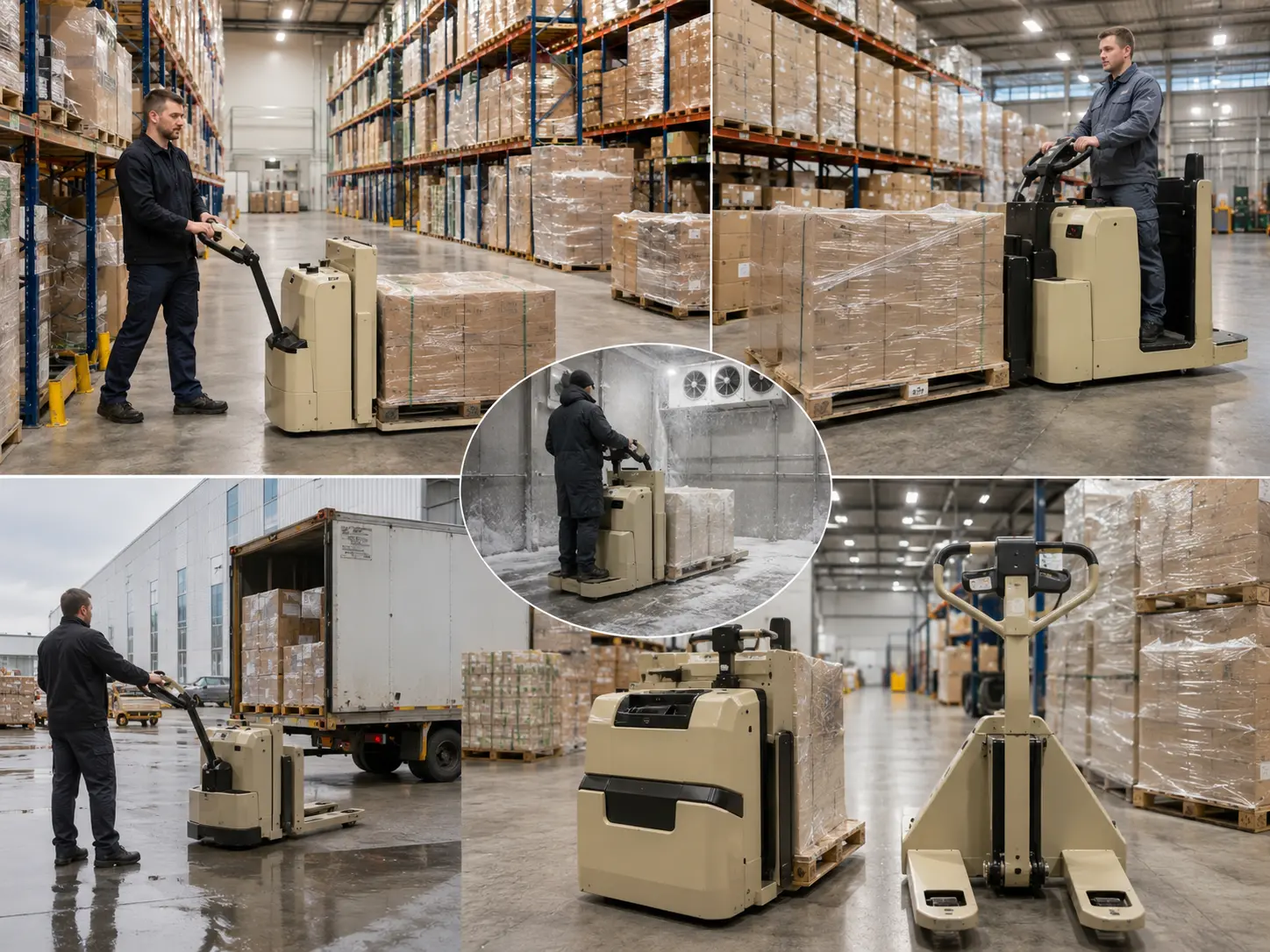
Electric Pallet Trucks Supplier
Frequently Asked Questions
1. What are Electric Pallet Trucks used for in warehouses?
Electric Pallet Trucks are used for moving palletized goods across short and medium distances inside warehouses, factories, loading docks, supermarkets, cold storage rooms, production areas, and distribution centers. They are especially useful for receiving goods, transferring pallets to storage areas, feeding packing lines, replenishing stock, loading trucks, and moving finished goods to dispatch zones. Compared with manual pallet trucks, electric models reduce operator effort and improve handling consistency during repetitive daily work.
2. How do I choose the right Electric Pallet Truck capacity?
To choose the right Electric Pallet Truck capacity, buyers should check the heaviest pallet weight, not only the average pallet weight. The selected truck should provide enough load margin for peak conditions, uneven pallet loading, wet floors, ramps, and daily operating stress. For many warehouses, 2.0-ton and 2.2-ton electric pallet trucks are practical choices for standard pallet movement, while heavier applications may require stronger configurations or manual backup equipment with higher rated capacity.
3. Are Electric Pallet Trucks better than manual pallet trucks?
Electric Pallet Trucks are better when the warehouse has frequent pallet movement, longer routes, heavier loads, operator fatigue, or higher productivity requirements. Manual pallet trucks are still useful for occasional movement, backup tasks, low-cost handling, and simple short-distance transfer. The best decision depends on daily pallet volume, route length, operator workload, budget, maintenance resources, and whether the warehouse needs powered movement or simple manual flexibility.
4. What type of Electric Pallet Truck is best for cold storage?
For cold storage, buyers should choose an Electric Pallet Truck designed for low temperature, humidity, and wet floor conditions. Important features include waterproof electric control, cold-resistant components, suitable wheel traction, corrosion-resistant structure, reliable handle operation, and stable low-speed control. Cold storage warehouses should not select a standard indoor truck without confirming whether the battery, controller, wheels, and structure can handle refrigerated or freezer environments.
5. What should buyers ask before ordering Electric Pallet Trucks?
Before ordering Electric Pallet Trucks, buyers should ask about rated capacity, battery type, battery capacity, charger configuration, fork size, lowered fork height, lift height, travel speed, wheel material, turning radius, brake system, spare parts, warranty support, delivery time, and whether the model is suitable for their warehouse layout. Buyers should also provide pallet size, pallet weight, aisle width, floor condition, shift schedule, and working temperature so the supplier can recommend a truck that fits real operating needs.
References
- “Powered Industrial Trucks eTool” — Occupational Safety and Health Administration — Warehouse Safety Resource
- “ISO 3691-1 Industrial Trucks Safety Requirements and Verification” — International Organization for Standardization — Industrial Truck Safety Standard
- “ANSI/ITSDF B56.1 Safety Standard for Low Lift and High Lift Trucks” — Industrial Truck Standards Development Foundation — Forklift and Pallet Truck Safety Standard
- “Warehousing and Storage: A Guide to Health and Safety” — Health and Safety Executive — Workplace Safety Guidance
- “Material Handling Equipment Selection Guide” — MHI — Material Handling Industry Resource
- “Battery Charging Safety for Powered Industrial Trucks” — Canadian Centre for Occupational Health and Safety — Workplace Battery Safety Resource
- “Ergonomic Guidelines for Manual Material Handling” — National Institute for Occupational Safety and Health — Ergonomics Reference
- “Cold Chain Logistics and Warehousing Best Practices” — Global Cold Chain Alliance — Cold Storage Operations Resource
How Electric Pallet Trucks Improve Warehouse Flow
How should buyers choose? Start with the warehouse route, not the product catalog. Measure pallet weight, aisle width, travel distance, floor condition, temperature, shift hours, and loading dock workflow. Then match the truck type, capacity, battery, fork size, wheel configuration, and operator position to those real operating conditions.
Why are Electric Pallet Trucks valuable? They reduce manual effort, improve short-distance pallet transfer, support cleaner indoor handling, and help warehouses control repetitive movement between receiving, storage, production, packing, and dispatch areas. The value is highest when operators move pallets frequently every day.
What problems do they solve? Electric Pallet Trucks address operator fatigue, slow manual movement, tight-space transfer, dock congestion, inefficient stock replenishment, and inconsistent pallet handling. In cold storage, specialized configurations can also help manage low-temperature and wet-floor challenges.
Option logic: If your warehouse is small and narrow, choose a compact walkie truck. If the route is long and frequent, choose a stand-on model. If the workplace is cold and humid, choose a cold storage configuration. If pallet movement is occasional, keep a manual truck as a backup. If the operation is multi-shift, prioritize battery uptime and charging strategy.
Consideration before purchase: The best model is not always the most powerful one. Oversized equipment can be difficult to maneuver, while undersized equipment can create safety and maintenance problems. A good selection balances capacity, route length, operator comfort, energy use, pallet compatibility, floor traction, service support, and total cost of ownership.
For B2B buyers, the next practical step is to turn warehouse conditions into a specification list before requesting a quote, so the selected truck solves real workflow problems instead of becoming another mismatched piece of equipment.