


High-bay warehouses are built for density, but density always asks for discipline. When a distribution center increases rack height to 12, 13, or even 15 meters and reduces aisle width to gain more pallet positions, the forklift is no longer just a lifting machine. It becomes part of a precision safety system. A small steering error, unstable pallet, poor floor condition, or delayed braking action can become expensive very quickly.
A VNA Forklift is designed to work where standard counterbalance forklifts and ordinary reach trucks cannot operate efficiently. It can support very narrow aisle storage, high-bay pallet racking, dense SKU management, and improved warehouse space utilization. But high lift height, narrow travel paths, mast movement, limited turning space, and reduced visibility mean buyers must evaluate safety features before purchase, not after the first rack strike. Warehouses do not like surprises. They are expensive and usually involve paperwork.
For companies comparing a VNA Forklift manufacturer, safety should be reviewed together with lift height, residual capacity, aisle width, guidance method, operator visibility, battery system, service support, and warehouse traffic rules. The goal is not simply to buy a truck that can reach the top beam. The goal is to operate safely, repeatedly, and productively at height.
VNA Forklift
Quick Decision Guide for VNA Forklift Safety Features
The safest VNA Forklift is not always the model with the tallest mast or the fastest travel speed. In high-bay racking, safety comes from matching the truck to the actual warehouse environment. A 3PL warehouse with mixed pallet weights needs different controls from a cold storage facility. An e-commerce fulfillment center with frequent picking needs different visibility support from a manufacturing parts warehouse handling heavy pallets.
Before selecting a truck, buyers should prepare rack height, top beam height, aisle width, pallet dimensions, load weight, load center, floor flatness data, guidance preference, traffic intersections, shift hours, battery requirement, operator mode, camera needs, and maintenance support expectations. If these details are still unclear, it is better to contact a VNA Forklift supplier before finalizing specifications. One wrong assumption in VNA planning can turn a space-saving project into a very narrow problem.
| Warehouse Risk | Recommended VNA Forklift Safety Feature | Why It Matters | Buyer Checkpoint |
|---|---|---|---|
| Mast sway at height | Mast stability control and lift-height speed limitation | Reduces load movement at high elevation | Confirm max lift height and residual capacity |
| Narrow aisle deviation | Rail guidance or wire guidance | Keeps the truck centered in the aisle | Confirm aisle width and guidance type |
| Poor pallet visibility | Fork camera and mast camera | Improves high-level placement accuracy | Check camera resolution and monitor position |
| Intersection collision | Automated speed reduction profiles | Reduces speed near aisle ends | Confirm programmable speed zones |
| Load instability | Load weight sensing and overload warning | Prevents unsafe lifting at height | Check load capacity at full lift height |
| Operator fatigue | Ergonomic cabin and adjustable controls | Reduces errors during long shifts | Test seat, joystick, display, and visibility |
What Makes a VNA Forklift Different in High-Bay Warehouses?
VNA Forklift Working Environment
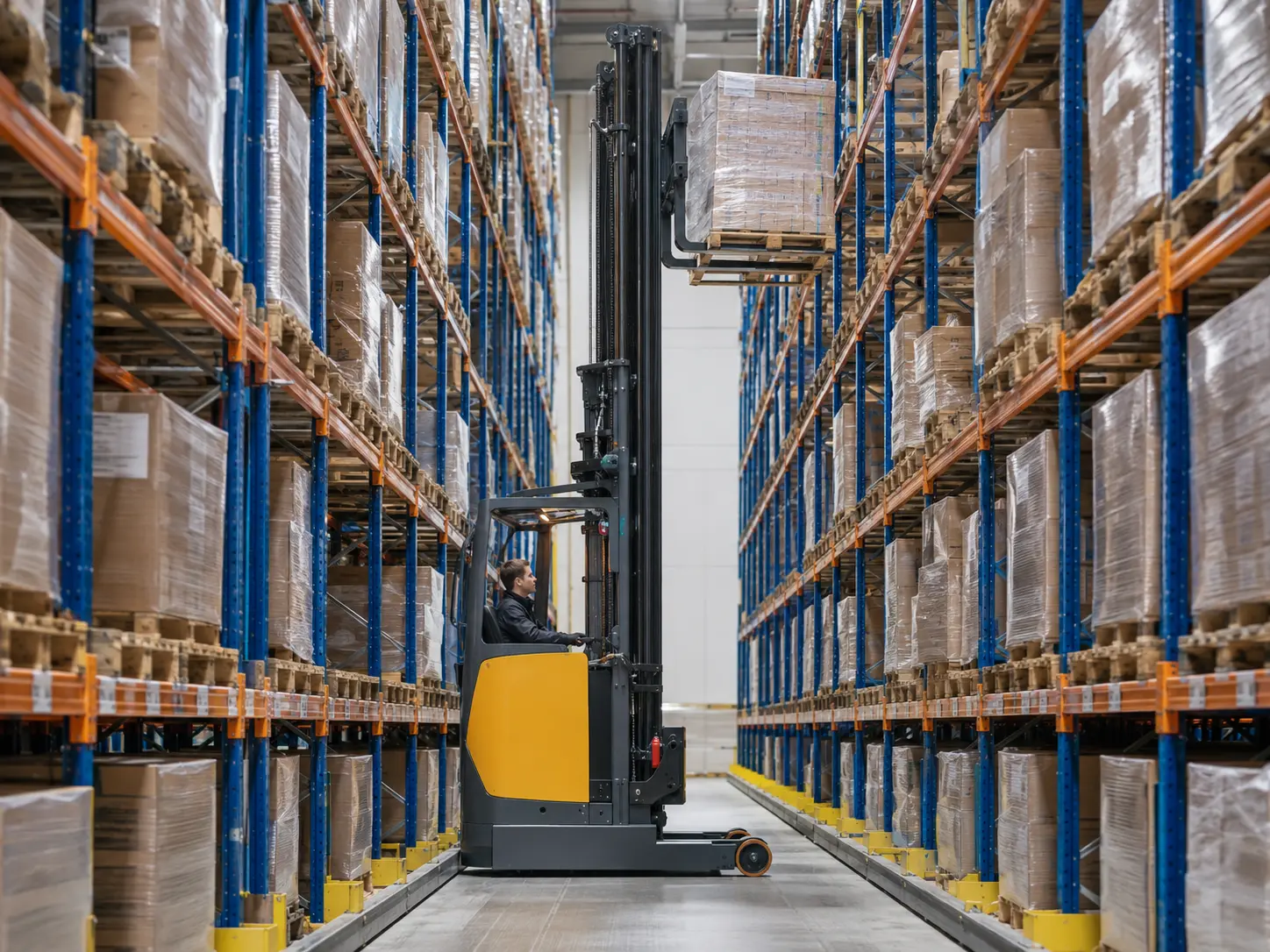
A VNA Forklift usually operates in very narrow aisle warehouses, high-bay pallet racking systems, 3PL distribution centers, e-commerce fulfillment centers, cold storage facilities, retail distribution hubs, pharmaceutical warehouses, and manufacturing parts storage areas. These environments share one goal: more storage capacity per square meter. The tradeoff is that aisles become tighter, lifts become higher, and operator decisions need stronger support from safety systems.
Compared with a standard forklift, a VNA truck has less freedom to turn inside the aisle. It often depends on rail guidance, wire guidance, or a controlled travel path. It may also require better floor flatness, stronger operator training, and more careful maintenance. The buyer should treat the truck, racking, floor, load, and guidance system as one combined warehouse solution.
Man-Up vs. Man-Down VNA Forklift
Man-up and man-down VNA forklifts solve different warehouse problems. A man-up design raises the operator platform with the load, giving better visibility for high-level picking and pallet placement. A man-down design keeps the operator at floor level, which may suit selected pallet-handling operations but usually depends more on camera assist and accurate positioning systems.
For buyers reviewing a complete VNA Forklift for high-bay racking, the decision should be based on picking method, lift height, pallet access frequency, operator visibility, load type, and aisle control. If the warehouse needs high-level case picking, man-up may be more suitable. If the operation focuses on pallet movement with camera-supported visibility, man-down may be practical.
| VNA Type | Best Use | Safety Advantage | Buyer Concern |
|---|---|---|---|
| Man-up VNA forklift | Case picking and high-level pallet placement | Better direct visibility at height | Operator cabin safety and rescue planning |
| Man-down VNA forklift | Pallet movement and selected warehouse layouts | Operator remains at floor level | Requires reliable camera visibility at height |
| Guided VNA forklift | Long narrow aisles | Reduces steering error | Floor, rail, or wire system must be accurate |
| Automated VNA forklift system | High-repeat warehouse workflows | Reduces human steering variability | Requires stronger system integration |
Top 10 VNA Forklift Safety Features Buyers Should Evaluate
1. Mast Stability Control for High-Lift Operation
At 15 meters, a mast does not behave like it does at 4 meters. Small floor variation, sudden braking, load shift, or steering correction can create visible sway. Mast stability control helps reduce load movement, improve pallet placement, and lower the chance of rack contact. This is especially important when operators place pallets near upper beams where visibility and clearance are limited.
If the warehouse operates above 10 meters, mast stability should be treated as a primary safety feature. If the pallet load is heavy or irregular, buyers should also review residual capacity and load center discipline carefully.
2. Residual Capacity Monitoring and Overload Warning
Nominal capacity is not enough. A forklift that can lift a certain load near ground level may not safely lift the same load at maximum height. Residual capacity changes with lift height, load center, mast design, attachments, battery weight, and load dimensions. A VNA Forklift working at high bay levels should help the operator understand whether the load is within the safe operating range.
Load weight sensing, overload warning, and clear capacity charts reduce dangerous assumptions. Operators should not rely on habit when working at height. Habit is useful until it becomes confidence wearing a blindfold.
3. Rail Guidance or Wire Guidance System
Very narrow aisles leave little room for steering error. Rail guidance uses physical guide rails to keep the truck aligned. Wire guidance uses floor-embedded wires and truck sensors to support automatic steering alignment. Both systems can improve aisle discipline and reduce side contact with racking.
If the warehouse has repetitive long-aisle travel, guided VNA operation is usually safer and more productive than manual steering alone. Buyers should compare installation cost, floor condition, maintenance, calibration, and future layout flexibility before choosing rail or wire guidance.
4. Lift-Height-Based Travel Speed Control
A VNA Forklift should not travel the same way with forks near the ground and with the mast elevated. As lift height increases, travel speed and acceleration should become more controlled. Lift-height-based speed limitation helps reduce mast sway, sudden movement, and hard braking near the racking.
This feature is especially important in warehouses where operators raise, travel, place, lower, and repeat hundreds of times per shift. Controlled speed does not simply reduce risk; it also improves operator confidence and placement consistency.
Automated Speed Reduction Profiles in Narrow Intersections
Aisle ends and cross-aisle intersections are high-risk zones because multiple movement paths meet. A VNA truck may exit a guided aisle, another truck may cross, pedestrians may be nearby, and racking can block visibility. Automated speed reduction profiles help reduce travel speed before the operator reaches these points.
This feature can be programmed by zone, lift height, aisle location, or warehouse traffic policy depending on system capability. It can reduce collision severity, improve predictable traffic behavior, and protect rack corners. For buyers comparing a sit-down reach truck with a dedicated VNA system, intersection control is one reason high-density warehouses often require more than a general reach solution.
| Zone Type | Recommended Speed Control | Why It Matters |
|---|---|---|
| Aisle entry | Reduced acceleration | Prevents sudden movement into a guided aisle |
| Aisle exit | Automatic slowdown | Reduces collision risk at blind transitions |
| Cross-aisle intersection | Programmable speed zone | Protects mixed traffic areas |
| Picking zone | Low-speed creep mode | Improves pallet handling accuracy |
| End-of-aisle turning area | Speed and steering restriction | Reduces tip and impact risk |
5. Real-Time Fork Camera and Mast Camera Assist
At high-bay levels, direct visibility is limited. Fork camera and mast camera systems help operators see fork tips, pallet entry, rack beam clearance, load placement, and upper-level alignment. This reduces guesswork and helps prevent pallet damage, rack impact, and incorrect placement.
Camera quality matters. Buyers should check resolution, low-light performance, lens protection, monitor placement, image stability at height, and whether the display can be viewed without neck strain. A camera that creates distraction instead of clarity is just an expensive tiny television.
6. Active Cabin Ergonomics and Operator Presence Detection
Operator fatigue is a safety issue, not a comfort luxury. VNA operators may work long shifts in repetitive narrow-aisle tasks where small mistakes matter. Adjustable seating, ergonomic joystick placement, low-vibration cabin design, clear displays, logical warning signals, and emergency controls within easy reach all help reduce error.
Operator presence detection can also prevent unsafe movement when the operator is not properly positioned. For cold storage, heated cabins, anti-fog displays, and glove-friendly controls may become essential rather than optional.
7. Side Clearance Sensors and Rack Impact Protection
VNA aisles leave limited side clearance. Side sensors, rack protection logic, and proximity warnings help reduce contact with uprights, beams, pallets, and aisle protection systems. Rack impact is not only a repair issue; it can affect structural safety and inventory stability.
Sensor placement should match actual load dimensions and truck geometry. Buyers should confirm what the system detects, how quickly it responds, and whether warnings are clear enough for operators to act.
8. Emergency Braking and Controlled Lowering
Emergency response features matter because high-bay operation adds recovery complexity. Emergency stop, regenerative braking, automatic parking brake, controlled lowering, hydraulic safety valves, battery isolation, and maintenance mode all help manage abnormal events.
Buyers should ask what happens if power fails at height, how the operator is lowered, how maintenance teams access the truck, and what inspection is required after an emergency stop or impact event.
9. Fleet Monitoring and Operator Access Control
Modern VNA forklifts increasingly use operator login, impact records, speed history, lift usage data, battery status, fault codes, pre-shift checklists, maintenance alerts, and telematics dashboards. These tools help supervisors identify risky behavior, repeated impacts, poor battery habits, and maintenance needs before they become larger problems.
If a warehouse has multiple operators and shifts, access control is especially useful. It ensures that only trained operators use the truck and helps connect safety events to training improvements.
10. Battery Safety and Energy Management
Battery performance affects both productivity and safety. A VNA Forklift that loses power predictability during a long shift can create planning issues. Buyers should compare lead-acid, lithium, charging method, shift duration, battery monitoring, charging area safety, and service support.
For cold warehouses, battery chemistry, charging behavior, and temperature performance need extra attention. Cold conditions do not forgive weak planning. They simply make it colder and more expensive.
Mitigating Mast Sway and Tipping Risks at 15-Meter Heights
Why 15-Meter High-Bay Operation Requires More Than Normal Forklift Safety
At 15 meters, the truck must manage mast extension, load height, load center, floor flatness, dynamic movement, residual capacity, and rack alignment at the same time. A small floor defect that seems minor at ground level can feel much larger at height. Sudden acceleration, braking, or steering correction can increase sway. Incorrect load center can reduce stability. Poor pallet condition can create additional movement.
This is why buyers should never select a VNA Forklift only by maximum lift height. The truck must also have usable residual capacity, stable mast behavior, appropriate guidance, suitable speed control, and operator visibility. If the warehouse needs a narrower but not full VNA-level solution, models such as an N15 narrow aisle forklift may be part of a broader equipment comparison, especially when aisle width, rack height, and load profile do not require the most specialized VNA configuration.
Floor Flatness and Racking Alignment
High-bay VNA operation requires better floor quality than ordinary low-level warehouse handling. Floor flatness, floor levelness, rack plumbness, aisle straightness, and guidance calibration all affect truck behavior. If the floor is not suitable, the operator may experience more sway, guidance instability, and placement difficulty.
Before blaming the forklift, buyers should survey the warehouse floor and racking system. The best truck cannot fully compensate for a poor floor, badly aligned racking, or a layout that ignores turning zones.
Residual Capacity and Load Center Discipline
Residual capacity is one of the most important technical items in VNA selection. Buyers should ask for capacity at the required lift height and load center, not only rated capacity on the brochure. The load center assumption must match the actual pallet and product dimensions. Attachments, side-shift systems, and special forks can reduce capacity.
| Risk Factor | Safety Feature | Buyer Check |
|---|---|---|
| Mast sway | Mast stability control | Test with target load and height |
| Overload | Load weight sensor | Confirm residual capacity data |
| Aisle deviation | Rail or wire guidance | Check aisle width and calibration |
| Poor visibility | Camera assist | Check monitor clarity and camera placement |
| Sudden speed | Lift-height speed control | Confirm programmable profiles |
| Floor variation | Floor flatness verification | Survey before implementation |
| Rack impact | Side sensors | Confirm detection range |
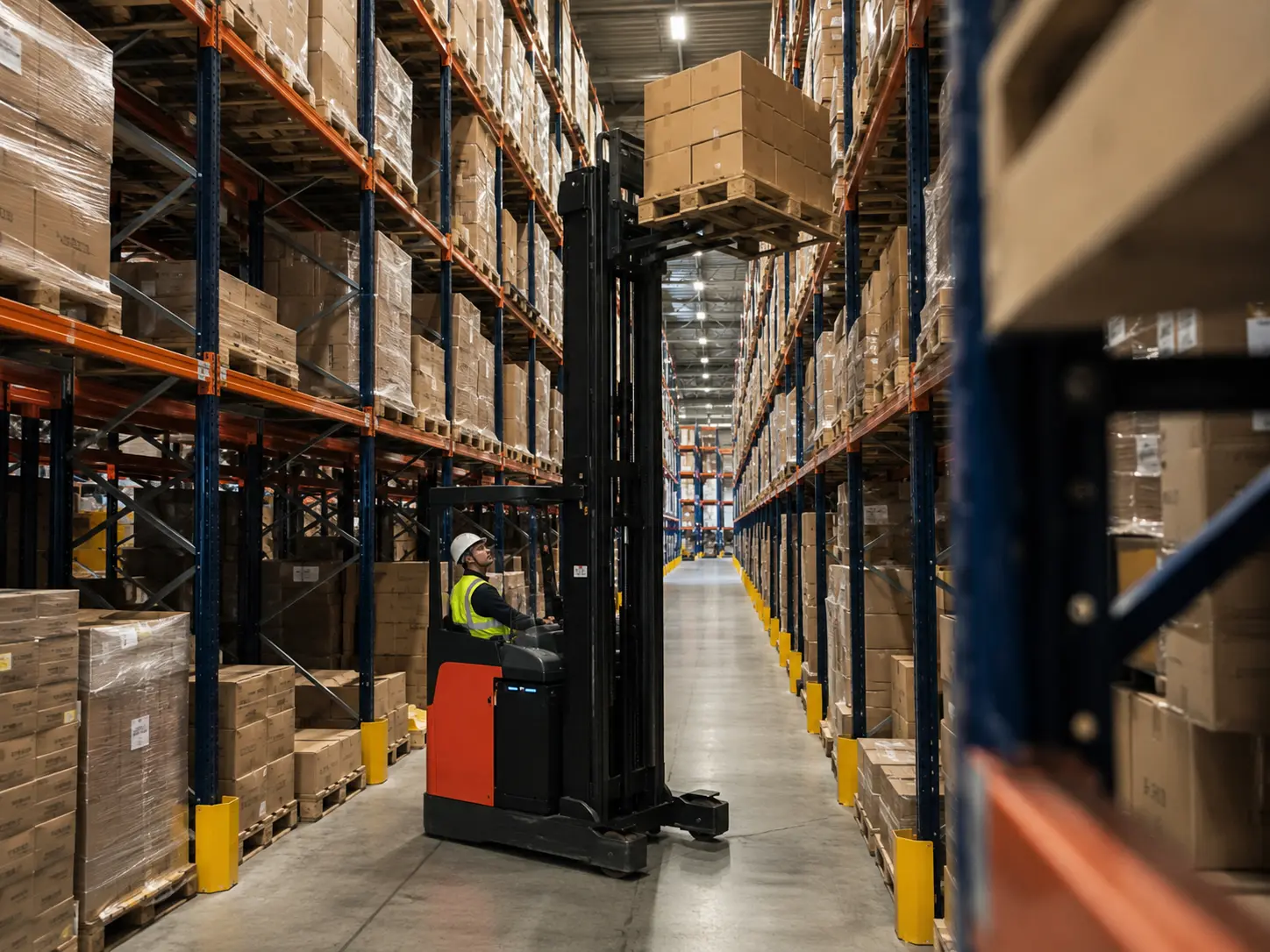
VNA Forklift Supplier
Active Cabin Ergonomics and Real-Time Camera Assist Systems
How Ergonomics Reduces Operator Error
In a very narrow aisle, operator comfort directly affects safety. Poor posture, awkward controls, unclear displays, vibration, cold temperature, and poor visibility increase fatigue. Fatigue increases mistakes. In high-bay racking, mistakes can become rack strikes, pallet damage, incorrect placement, or emergency stoppages.
A strong VNA Forklift cabin should support comfortable seating, logical joystick movement, clear display hierarchy, easy emergency control access, low vibration, good forward and upward visibility, and operator confidence during high-level placement. For a warehouse that does not need full high-bay VNA capability but still needs improved aisle efficiency, an N20 narrow aisle forklift may be reviewed as part of the equipment selection logic.
Camera Assist Systems That Actually Help
Camera assist should improve decisions, not distract the operator. Useful views include fork tip view, pallet entry view, rack beam clearance, rear travel view, aisle-end monitoring, overhead mast view, and low-light aisle assist. The monitor should be placed where the operator can see it without excessive head movement.
Buyers should test camera performance at actual lift height, not only at ground level. The image must remain stable when the mast is elevated. The lens should resist dust and vibration. The monitor should be bright enough for warehouse lighting but not so bright that it becomes distracting during night shifts.
Operator Display and Warning Design
The operator display should show lift height, load weight, speed mode, battery status, fault warnings, guidance status, camera feed, maintenance alerts, and pre-shift inspection reminders. However, more information is not always better. If the display is overloaded, operators may miss critical warnings.
Good warning design uses clear priority. A low battery reminder should not look as urgent as an overload warning. A guidance status indicator should be easy to understand. A system that constantly beeps for minor issues may train operators to ignore the next serious alarm. Annoying alarms are like warehouse mosquitoes: eventually everyone stops listening.
Material Parameters and Technical Specifications Buyers Should Compare
| Specification | Why It Matters | Buyer Question |
|---|---|---|
| Max lift height | Matches high-bay racking height | Can it safely reach the top beam? |
| Residual capacity | Defines safe load at height | What capacity remains at full height? |
| Aisle width requirement | Determines layout compatibility | What minimum aisle width is required? |
| Guidance type | Controls steering accuracy | Rail, wire, laser, or manual guidance? |
| Battery system | Affects shift duration and charging plan | Lead-acid, lithium, or other system? |
| Travel speed | Affects productivity and safety | Are speed profiles programmable? |
| Camera system | Supports placement visibility | Which camera views are included? |
| Floor requirement | Affects stability and guidance | What flatness tolerance is required? |
VNA Forklift Safety Feature Priorities by Warehouse Type
E-Commerce Fulfillment Centers
E-commerce fulfillment centers often manage many SKUs, frequent picks, fast replenishment, and high operator activity. Safety priorities include operator access control, camera assist, speed zones, fleet monitoring, battery management, and guidance accuracy. The goal is to reduce mistakes without slowing the warehouse into sadness.
Cold Storage Warehouses
Cold storage facilities need special attention because low temperature affects operators, batteries, visibility, and electronics. Heated cabins, anti-fog camera systems, cold-rated battery support, ergonomic controls, reliable braking, and moisture-resistant electronics are important. Buyers planning freezer operations should review a cold storage forklift selection guide before choosing the final VNA configuration.
3PL Warehouses
Third-party logistics warehouses handle mixed clients, changing pallets, varied SKU sizes, and multiple operators. They need load monitoring, operator login, programmable speed limits, fleet data, guidance flexibility, and maintenance alerts. A 3PL operation benefits from safety data because it helps managers detect repeated impacts, unsafe behaviors, and training gaps.
Manufacturing Parts Warehouses
Manufacturing parts warehouses may store heavy, irregular, or high-value loads. Residual capacity display, mast stability, camera assist, side clearance sensors, and load center control should be prioritized. If loads are not uniform, the truck must help operators avoid assumptions.
Man-Down VNA Forklift Safety Considerations
A man-down VNA Forklift can be useful when the operator does not need to rise with the load and the warehouse workflow focuses on pallet handling rather than elevated case picking. However, because the operator remains at floor level, camera visibility, fork positioning assistance, guidance accuracy, and load placement feedback become more important.
Buyers comparing a man-down VNA forklift should review required lift height, pallet visibility, camera system, aisle guidance, residual capacity, operator comfort, and emergency procedures. If the operator cannot see the placement clearly, the truck must provide reliable visual assistance. Guesswork at high level is not a warehouse strategy. It is a suspense movie with pallets.
Regulations and Safety Standards Buyers Should Know
Powered Industrial Truck Training and Safe Operation
Warehouse buyers should treat operator training, inspection, maintenance, and safe operating procedures as part of the VNA Forklift purchase. A safer truck still requires trained operators, site-specific risk assessment, controlled traffic flow, and routine inspection. Equipment features reduce risk, but they do not replace training.
ANSI and ISO Safety Frameworks
ANSI/ITSDF B56.1 is widely used as a safety standard for low lift and high lift industrial trucks. ISO 3691-1 provides safety requirements and verification principles for several types of self-propelled industrial trucks. For international warehouse projects, buyers should ask suppliers which standards, testing processes, and documentation apply to the specific VNA model and destination market.
Warehouse Risk Assessment
A site-specific risk assessment should review aisle width, pedestrian routes, load weight, rack height, floor quality, lighting, traffic intersections, emergency rescue, operator training, maintenance plan, and battery charging areas. This is especially important when implementing VNA forklifts in an existing warehouse rather than a newly designed facility.
Common Buyer Mistakes When Choosing a VNA Forklift
Mistake 1: Choosing by Lift Height Only
A truck that reaches 15 meters is not automatically safe or productive at 15 meters. Without enough residual capacity, mast stability, camera visibility, and floor suitability, the headline lift height can become misleading.
Recommendation: compare usable capacity, mast stability, guidance compatibility, and speed control at the actual operating height.
Mistake 2: Ignoring Floor Flatness
Poor floors increase mast sway, guidance errors, operator discomfort, and rack impact risk. VNA systems need warehouse floor quality to support high-bay precision.
Recommendation: survey floor flatness and rack alignment before finalizing the forklift specification.
Mistake 3: Underestimating Camera and Visibility Needs
At high levels, operators need help seeing fork position, pallet entry, and rack clearance. Weak camera systems can reduce accuracy and confidence.
Recommendation: test camera clarity, monitor placement, and visibility at the target lift height before purchase.
Mistake 4: Not Programming Speed Zones
Aisle ends and intersections create collision risk. Manual judgment alone may not be enough during busy shifts.
Recommendation: use automated speed reduction profiles where aisle transitions, pedestrians, and cross-traffic exist.
Mistake 5: Buying Without Operator Trial
Cabin comfort, control layout, display clarity, and visibility affect real safety. A truck that looks good in a brochure may feel awkward after six hours of operation.
Recommendation: let operators test the truck under realistic warehouse conditions.
Mistake 6: Ignoring Maintenance Capability
Advanced safety systems need calibration, inspection, spare parts, and trained service support. Without maintenance capability, sensors and cameras may become decorations.
Recommendation: confirm local service, diagnostics, spare parts, software support, and maintenance training.
Buyer RFQ Checklist for VNA Forklift Projects
| RFQ Item | What Buyers Should Provide | Why It Matters |
|---|---|---|
| Warehouse layout | Aisle width, rack length, turning zones, traffic map | Confirms VNA compatibility and guidance needs |
| Rack height | Top beam height and required lift height | Defines mast and residual capacity requirement |
| Load data | Pallet size, load weight, load center | Prevents unsafe capacity assumptions |
| Floor condition | Flatness, levelness, joint condition, surface quality | Affects stability and guidance performance |
| Guidance preference | Rail, wire, semi-automatic, or manual | Controls aisle alignment and installation planning |
| Camera requirement | Fork, mast, rear, side, or aisle-end views | Improves visibility and placement accuracy |
| Shift conditions | Hours, temperature, battery preference, charging plan | Determines energy and operator comfort needs |
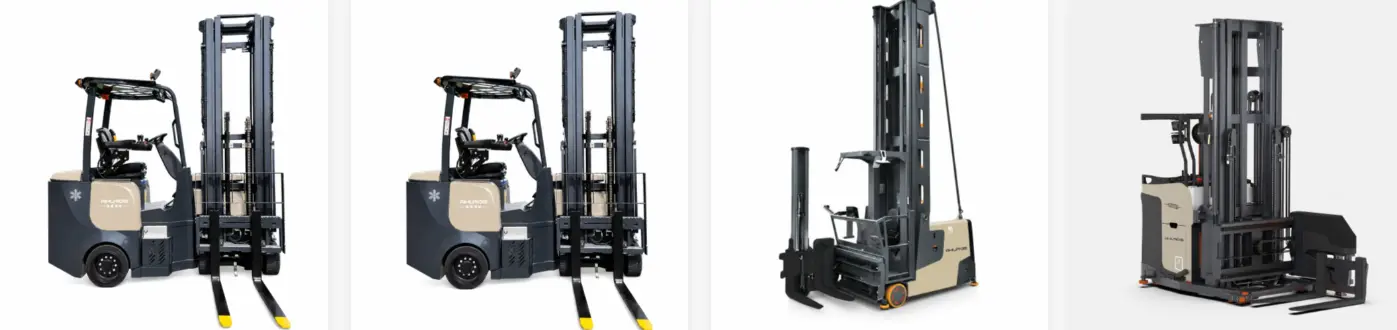
High-quality VNA Forklift
Final Recommendation: Match the VNA Forklift to the Risk, Not Just the Rack Height
A VNA Forklift for high-bay racking should be selected by operating risk. Lift height matters, but it is only one part of the decision. Buyers also need to evaluate residual capacity, mast stability, aisle guidance, camera assist, speed zones, operator ergonomics, emergency response, battery system, floor flatness, and maintenance support.
If the warehouse works above 10 meters, prioritize mast stability, residual capacity data, lift-height speed control, and camera assist. If aisles are extremely narrow, prioritize rail or wire guidance. If traffic crosses at aisle ends, prioritize automatic speed reduction zones. If operators work long shifts, prioritize cabin ergonomics and clear displays. If the facility is cold storage, confirm battery, cabin, camera, and electronics suitability.
Before choosing a VNA Forklift, prepare the warehouse layout, aisle width, rack height, pallet weight, load center, floor flatness report, guidance preference, traffic map, shift schedule, temperature conditions, and safety requirements. A professional high-bay warehouse forklift manufacturer can then help match the right safety features to the real operating environment.
Frequently Asked Questions About VNA Forklift Safety
1. What safety features should a VNA Forklift have for high-bay racking?
A VNA Forklift for high-bay racking should include mast stability control, residual capacity monitoring, load weight sensing, rail or wire guidance, lift-height-based speed control, automated speed reduction zones, fork camera or mast camera assist, side clearance sensors, ergonomic cabin controls, emergency braking, controlled lowering, operator access control, and maintenance alerts. The exact feature package should match the warehouse height, aisle width, load weight, floor flatness, traffic flow, and operator shift conditions. Buyers should not select a VNA Forklift by maximum lift height alone.
2. How high can a VNA Forklift lift safely?
The safe lift height of a VNA Forklift depends on the model, mast design, residual capacity, load center, pallet weight, floor flatness, guidance system, and operating environment. Some high-bay warehouses may operate around 10 to 15 meters, but the important question is not only whether the truck can reach that height. Buyers must confirm how much load the truck can safely handle at the required height, whether speed is limited during high-lift operation, and whether camera assist or guidance systems support accurate placement.
3. Is rail guidance or wire guidance better for VNA forklifts?
Rail guidance and wire guidance can both improve VNA Forklift safety in very narrow aisles, but they suit different warehouse conditions. Rail guidance uses physical guide rails and is robust, visible, and mechanically straightforward. Wire guidance uses embedded floor wire and sensors, creating a cleaner aisle appearance but requiring accurate installation and calibration. The better option depends on aisle width, floor condition, installation budget, future layout changes, maintenance capability, and traffic flow. Buyers should compare both systems before finalizing the VNA layout.
4. Why do VNA forklifts need automatic speed reduction?
VNA forklifts need automatic speed reduction because high lift heights, narrow aisles, aisle exits, and cross-traffic intersections increase the risk of collision, mast sway, and unstable movement. Automated speed profiles can slow the truck near aisle ends, reduce acceleration in transition zones, and make traffic behavior more predictable. This is especially useful where pedestrians, other trucks, or blind corners are present. Speed reduction should be programmed according to warehouse risk zones, lift height, guidance system, and traffic rules.
5. What should buyers check before purchasing a VNA Forklift?
Before purchasing a VNA Forklift, buyers should check rack height, required lift height, aisle width, pallet size, maximum load weight, load center, residual capacity at full height, floor flatness, guidance type, camera system, speed control profiles, battery system, operator cabin ergonomics, emergency lowering procedure, maintenance support, spare parts availability, and compliance documentation. Buyers should also test the truck under realistic operating conditions whenever possible, especially if the warehouse has high-bay racking, cold storage, heavy loads, or narrow intersections.
References
- Powered Industrial Trucks Training Assistance, Author: Occupational Safety and Health Administration, Institution: U.S. Department of Labor, Source: OSHA eTool.
- 29 CFR 1910.178 Powered Industrial Trucks, Author: Occupational Safety and Health Administration, Institution: U.S. Department of Labor, Source: OSHA Regulations.
- ANSI/ITSDF B56.1 Safety Standard for Low Lift and High Lift Trucks, Author: Industrial Truck Standards Development Foundation, Institution: ANSI and ITSDF, Source: ANSI Webstore.
- ISO 3691-1 Industrial Trucks Safety Requirements and Verification, Author: International Organization for Standardization, Institution: ISO, Source: ISO Standards Catalogue.
- ISO 3691-3 Industrial Trucks Additional Requirements for Trucks with Elevating Operator Position, Author: International Organization for Standardization, Institution: ISO, Source: ISO Standards Catalogue.
- Warehouse Safety: Powered Industrial Trucks, Author: National Safety Council, Institution: National Safety Council, Source: Workplace Safety Resources.
- Guidance on Warehouse Traffic Management, Author: Health and Safety Executive, Institution: HSE United Kingdom, Source: Workplace Transport Safety Guidance.
- Industrial Truck Operator Safety and Fleet Management Practices, Author: Material Handling Industry Research Contributors, Institution: MHI, Source: Material Handling and Logistics Safety Resources.
How Buyers Should Evaluate VNA Forklift Safety
How should buyers choose a VNA Forklift for high-bay racking?
Buyers should start with warehouse risk data: rack height, aisle width, pallet weight, load center, floor flatness, traffic intersections, operator shift length, and guidance requirements. The safest VNA Forklift is the one matched to the actual warehouse layout, not only the one with the tallest mast.
Why are mast stability and residual capacity critical?
At high lift heights, mast sway and reduced residual capacity can affect load placement, rack clearance, and operator confidence. Buyers should check capacity at the required lift height and load center, then confirm mast stability behavior with realistic warehouse loads.
What option works best for very narrow aisles?
For very narrow aisles, a guided VNA Forklift with rail or wire guidance is usually stronger than manual steering alone. Guidance helps keep the truck centered, reduces side contact risk, and improves consistency in long racking aisles.
What option works best for high-traffic warehouse intersections?
For warehouses with cross-aisle traffic, pedestrians, and blind aisle exits, automated speed reduction profiles are highly valuable. They reduce truck speed in programmed zones and make traffic behavior more predictable.
Consideration: What risks should be checked before purchasing?
Buyers should check residual capacity, floor flatness, aisle width, guidance compatibility, camera clarity, operator cabin comfort, emergency lowering, battery performance, maintenance support, and compliance documentation. These factors decide whether the truck can operate safely under real conditions.
Recommendation
If the warehouse operates at 12–15 meters, prioritize mast stability, camera assist, and lift-height-based speed control. If the warehouse has narrow intersections, add automated speed profiles. If the warehouse runs multiple shifts, choose fleet monitoring and operator access control. If the warehouse is cold storage, confirm cold-rated battery, cabin, and visibility systems.
Before selecting a VNA Forklift, prepare your rack height, aisle width, pallet load data, floor flatness, guidance preference, operator mode, traffic map, shift schedule, and maintenance expectations. A professional VNA Forklift supplier can help configure the safest truck for your high-bay warehouse.